
Constable O. A. Ash: Complete Testimony on the Aimee McPherson Kidnapping Investigation (1926)
Arlin E. Nusbaum
July 19, 2026
Introduction
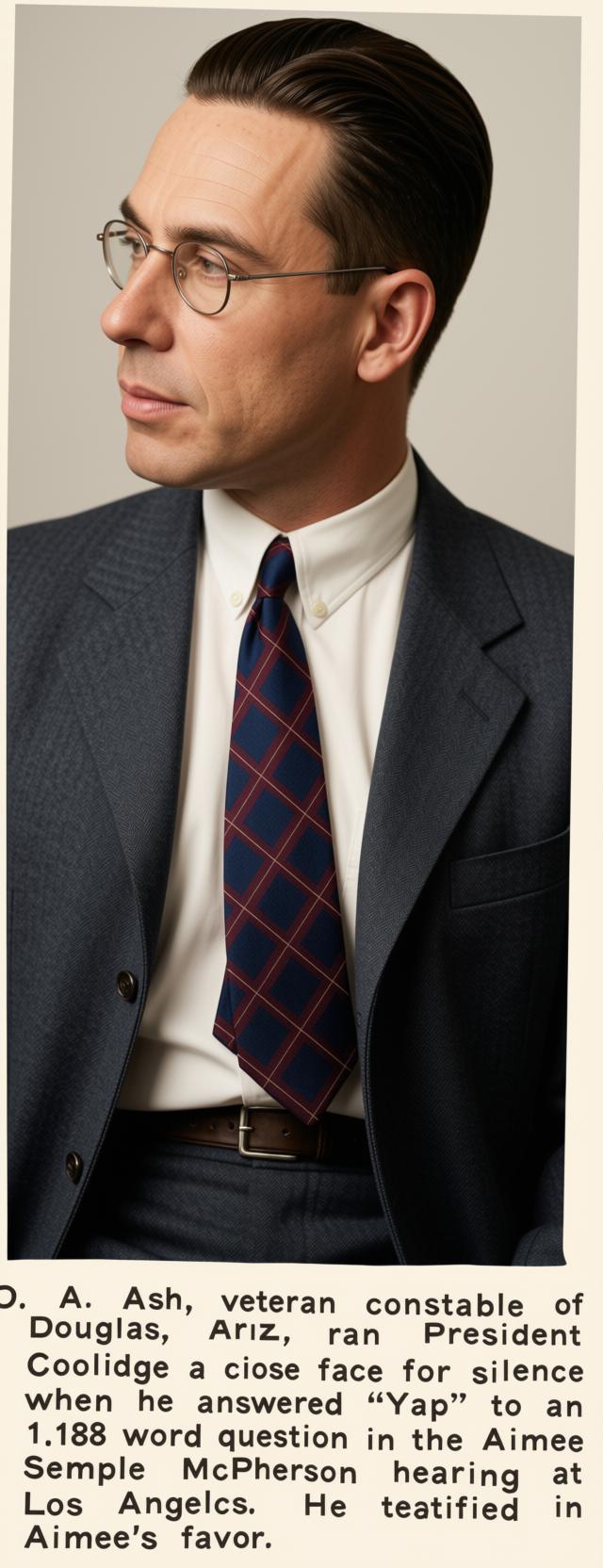
Constable O. A. Ash of Douglas, Arizona was the most credible first-hand witness in the 1926 Aimee Semple McPherson kidnapping investigation. Over seven months, Ash provided multiple accounts of his role in tracking McPherson's alleged escape route and discovering the shack where she claimed to have been held captive.
This document consolidates all known testimony from Constable Ash into a single, coherent narrative, sourced from three newspaper accounts spanning June 1926 to January 1927.
Research Note: This compilation is based on primary source documentation recovered from newspaper archives. The original "Angelus Sentinel" church bulletin (cited by the Madera Tribune as an intermediary source) has not been located in any digital archive.
Part I: Constable Ash’s Credentials
"I have been a police officer or a deputy sheriff since 1899, and I am now serving my second term as constable."
— Madera Tribune, January 18, 1927
"Mr. Ash has been a constable and deputy sheriff in Douglas many years. He is a man of middle age, quiet and conservative in speech and is a member of the Masonic fraternity. He has every appearance of telling the truth and of being most sincere in all he says and does."
— Redlands Daily Facts, October 29, 1926
Summary: Ash was a career law enforcement officer with approximately 27 years of experience as of 1926. He was the elected constable of the Douglas District in Cochise County, Arizona, and testified as a witness for the defense in McPherson's case.
Part II: Initial Contact with McPherson
How I Learned of the Case
Version A (October 29, 1926):
"Gonzales said the woman had stumbled across the doorway of his home and fallen in a faint. He and his wife picked her up, rubbed her with alcohol and partially restored her, and seeing that she was an American, summoned the American taxi, and directed that she be taken to Douglas. The driver took her passenger to the police department, and a police officer by the name of Cook sent her to the hospital, guaranteed her hospital bill, and summoned Constable Ash."
Version B (January 18, 1927):
"John Anderson, the cab driver who brought Mrs. McPherson across the border at the request of the mayor of Agua Prieta, did not heed the mayor's order to take her to the hospital because the woman in a semi-conscious condition continually called for the police. Therefore, Anderson took her first to the Douglas police station. That is how I learned of the case immediately."
Her Physical Condition Upon Arrival
Ash's description remained remarkably consistent across all accounts:
| Injury | Ash's Observation | Los Angeles Press Claim |
|---|---|---|
| Swollen ankles | ✅ Verified | ❌ Denied |
| Blistered soles | ✅ Verified | Not addressed |
| Burned/welted wrists | ✅ Verified | ❌ Denied |
| Torn pocket | ✅ "One pocket was torn from her gingham dress" | Not addressed |
| Holes in stockings | ✅ Verified | ❌ Denied |
Part III: Organizing the Search
"I know the border country well and I have had considerable training in tracking, so when I heard the evangelist's story I organized a party to search for the shack and to hunt for the kidnappers."
Search Party Members:
- Constable O. A. Ash (lead investigator)
- Leslie Gatliff (lieutenant, Douglas Police Department)
- Unnamed Indian tracker
- Additional posse members
"Accompanied by an Indian and Leslie Gatliff, lieutenant of the Douglas police department, I back-trailed Mrs. McPherson..."
— Madera Tribune, January 18, 1927
Part IV: The Terrain
Ash's most important contribution was correcting the misinformation spread by Los Angeles newspapers about the desert terrain.
"The country there is not a desert as reported. On the contrary, it is a grassy, well watered spot, a fine cattle country."
"The elevation there is approximately 5000 feet and the country the woman traveled over was grassy, in some cases the grass being up to one's knees. It is the exact opposite of a desert—yet the Los Angeles papers insist upon calling it a desert."
Temperature Reading:
"The maximum temperature reached the day Mrs. McPherson walked across the grassy country was 96 degrees; at least, that's what it was in Douglas."
Ash's Defense Against Skepticism:
"Please observe that the shoes I now have on have not the slightest scratch, yet I walked days and nights over the grassy country in search of Mrs. McPherson's trail... When I testified in Los Angeles on Tuesday and Wednesday I wore a silk-finished alpaca suit which contained no blemishes, despite the fact that I had worn it constantly two days and two nights when I finally arrived at the shack which the evangelist had described to me."
Part V: Tracing the Route
Specific Route Details:
| Segment | Direction | Distance | Terrain Feature |
|---|---|---|---|
| Leg 1 | East from Douglas | 9 miles | Along fence toward Niggerhead Mountain |
| Leg 2 | South | 9 miles | Along Galardo ranch fence |
| Gap | N/A | ~2 miles | Lost due to cattle tracks |
| Total | East then South | 20 miles | Combined distance |
Tracking Methodology:
"We set out in the general direction indicated by the woman and soon picked up her trail. We followed it and finally came to the fence she described. There it was easy to track her and we did so without difficulty for miles. The grass or weeds would be broken down; a stone dislodged, and occasionally there would be a footprint. Her shoes fitted these prints."
Shack/cabin discovered:
"We tracked her indisputably to within a mile and a half of a cabin, and the house answered her description of the place where she was held captive."
Part VI: The Shack Discovery
Timeline of Discovery:
| Date | Event | Status |
|---|---|---|
| June 26, 1926 | Initial shack located based on footprints | ✅ Shack found ❌ Fetters NOT YET FOUND |
| August 18, 1926 | Second verification with McPherson's help | ✅ Confirmed shack identity ✅ Fetters found |
Initial Discovery (June 26, 1926):
"The discovery of a shack 18 miles southeast of Agua Prieta, Sonora, Mexico, by a searching party under Constable O. A. Ash, who identified it from descriptions as the one in which Aimee Semple McPherson, Los Angeles evangelist, said she was held captive, marked the only development here today in the investigation into the alleged kidnapping of the evangelist."
"The cabin was located, according to Ash, after difficult tracking over desolate prairies."
"The windows of the cabin were barred, Ash said, and one of them had been broken. There were four rooms in the structure, the greater part of which was of adobe brick."
Confirmation Discovery (August 18, 1926):
"Then, on August 18 that was after Mrs. McPherson had returned to that region to help officers hunt the cabin where she had been held prisoner we found the shack that the evangelist and the other officers failed to find. Lieutenant Gatlitf was the first to spy the place. The shack was really a miner's cabin at the abandoned San Juan gold and copper mine."
Part VII: Physical Evidence Found
The Binding Materials
| Item | Description | Purpose | Status |
|---|---|---|---|
| Oil can | Five-gallon | Cut binding strips | ✅ In custody |
| Rawhide strands | Found in room and outside door | Binding material | ✅ Found |
| Heavy ducking | Fabric strips | Binding material | ✅ Found |
| Bed ticking strips | Cloth binding | Wrist/ankle bindings | ✅ Found |
| Can-opener marks | Rough edge on can | Cut the bindings | ✅ Verified |
"Her hands and feet were not bound with rope, but with strips of cloth similar to bed ticking."
"In this shack we found the can which has been opened with can-opener, and we could see that the rough edge had been used to cut the bed ticking strips which apparently had bound the woman's wrists and ankles."
Secondary Finding: Horse Tracks
"Throughout the time the posse has been attempting to find the shack, according to the constable, it has encountered the tracks of a shod horse, parallel to the woman's footprints. During the search the party came upon a fence through which the woman's tracks passed, and through which the horseman had cut a gap. He expressed the belief that the woman who made the tracks was followed later by a rider."
Part VIII: Critique of Los Angeles Press
Witness Misquotations:
"Los Angeles newspapers certainly can lie. While eating my lunch in Los Angeles the other day I purchased a newspaper which gave a full account of the testimony of M. R. Irvine, a photographer from Douglas. But Irvine had not yet been on the witness stand and did not get to testify until two and one-half hours after I read his alleged testimony in the paper."
Withholding Facts From Public:
"He declares that 'honest facts concerning the case of Aimee Semple McPherson have been withheld from the public' and that Los Angeles newspapers had deliberately misinformed their readers regarding important phases of the evangelist's kidnaping story."
Final Assessment:
"In conclusion I might add that California certainly has some prize winning liars."
Part IX: Ash’s Position on the Case
"I do not know anything about the case prior to it coming under my observation," continued Constable Ash, "I know nothing of the woman, her motives, nor how she got to the cabin. All I know is that we tracked her, beyond all possibility of a mistake, to within a mile and a half of the cabin; that she came exhausted to the cabin of Gonzales and had to be revived there; that she was taken to the hospital in Douglas and that there her feet were blistered, her ankles swollen, her wrists and arms burned, welted and swollen. And we have the can and bandage with which she was bound, and have it in safe keeping. The other officers who had to do with the case in and around Douglas will substantiate all these things."
Appendix A: Chronological Summary
| Date | Event | Documentation |
|---|---|---|
| May 18, 1926 | McPherson disappears from Venice Beach | Background event |
| June 23, 1926 | McPherson reappears in Douglas hospital | Background event |
| June 26, 1926 | Shack initially located by Ash's party | San Bernardino Daily Sun, June 27 |
| June 27, 1926 | Ash interview published (AP wire) | San Bernardino Daily Sun |
| August 18, 1926 | Shack confirmed with McPherson's help | Madera Tribune |
| October 1926 | Ash testifies in Los Angeles grand jury | Madera Tribune |
| October 29, 1926 | Ash gives interview at Redlands office | Redlands Daily Facts |
| January 10, 1927 | DA Keyes drops all charges | Background event |
| January 18, 1927 | Madera Tribune publishes Ash interview | Madera Tribune (& Angelus Sentinel) |
Appendix B: Source Comparison Matrix
| Detail | Article 1 (Jun 27, 1926) |
Article 2 (Oct 29, 1926) |
Article 3 (Jan 18, 1927) |
|---|---|---|---|
| Shack found | June 26, 1926 | Not mentioned | August 18, 1926 |
| Fetters found | NOT YET FOUND | Can & bandage in custody | Bed ticking strips found |
| Wrist marks | Not mentioned | "Burned, welted and swollen" | "Marks made on wrists" |
| Route details | None | "Followed fence...canyon" | "Nine miles east...nine miles south" |
| Cab driver named | Not named | "Gonzales" | "John Anderson" |
| Leslie Gatliff named | Not mentioned | Not mentioned | Lieutenant, Douglas PD |
| LA press critique | Not present | "Different from LA colorings" | "Prize winning liars" |
| Source attribution | AP Wire | Redlands Daily Facts original | From Angelus Sentinel citing SBDS |
Conclusion
Constable Ash was the most credible first-hand witness in the McPherson kidnapping case. His account provides the primary evidentiary foundation for McPherson's claim, directly contradicting the skeptical stance of the Los Angeles press.
Strengths
- ✅ Career law enforcement officer (27+ years experience)
- ✅ Local expert on border terrain
- ✅ Physical evidence in custody (oil can, bindings)
- ✅ Consistent core narrative across three separate accounts
- ✅ Independent of McPherson's church/following
- ✅ Corroborated by other Douglas officers
Sources Used
- San Bernardino Daily Sun, June 27, 1926, Page 2 (Newspapers.com)
- Redlands Daily Facts, October 29, 1926 (Newspapers.com)
- Madera Tribune, January 18, 1927, Page 4 (CDNC.ucr.edu — MT19270118)
Citation: Arlin E. Nusbaum, "Constable O. A. Ash: Complete Testimony on the Aimee McPherson Kidnapping Investigation (1926)," SisterAimee.org, July 19, 2026.