The Aimee McPherson kidnapping as reported to the Elim movement in Britain. London · 1926–1927.
In May 1926, the American evangelist Aimee Semple McPherson vanished while swimming off the California coast. She was believed drowned; five weeks later, she reappeared in Mexico, telling of a kidnapping. What followed was a grand jury inquiry, a press campaign, a preliminary hearing, and, in January 1927, the quiet withdrawal of all charges.
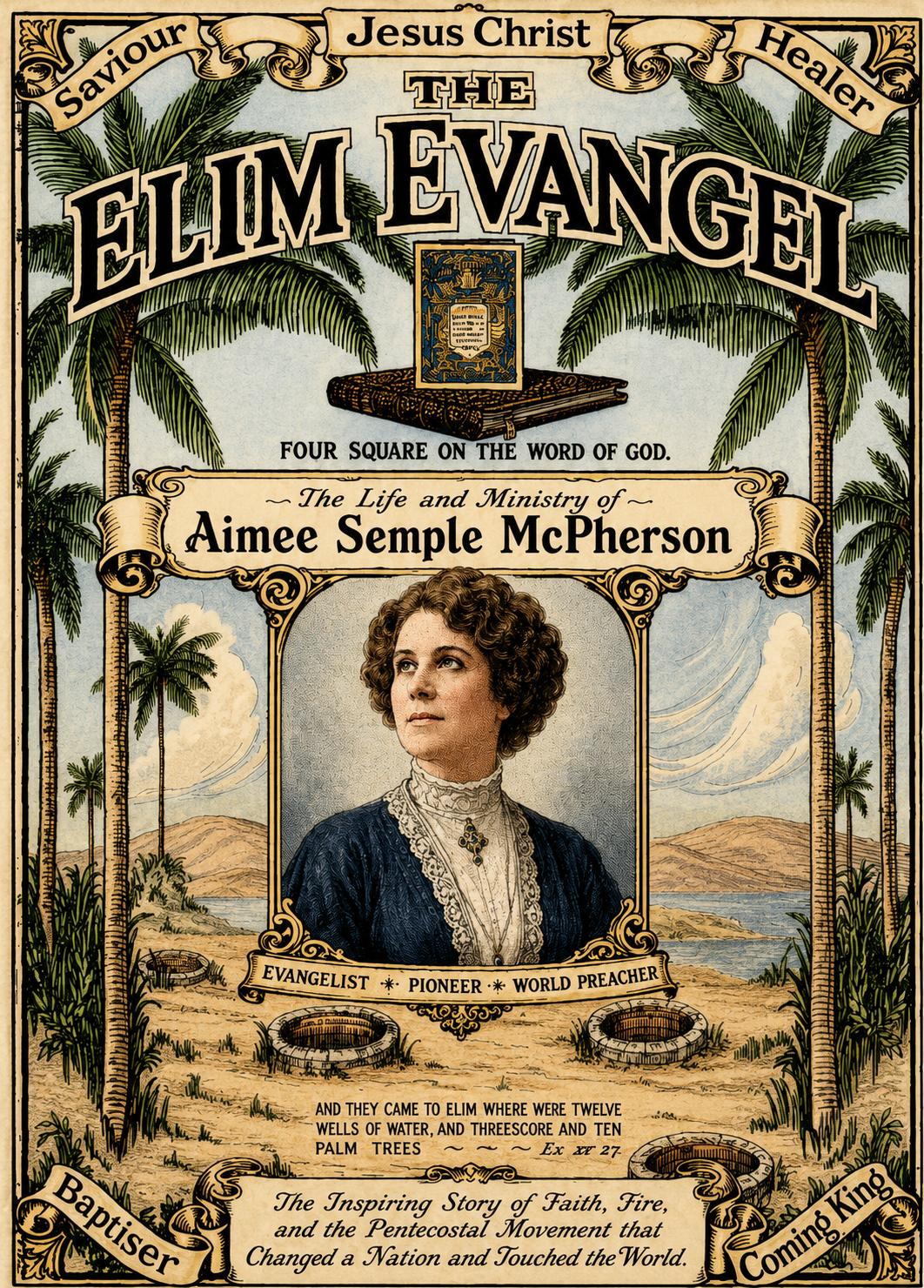
The Elim Evangel, the London weekly of the Elim Pentecostal Alliance, followed the affair from across the Atlantic and printed five pieces about it over those eleven months. Gathered here in one, they form a single documentary, moving from grief to testimony to family defense to vindication. Each is transcribed from the original printing; spelling and punctuation follow the source, and each chapter opens with a facsimile of the page on which it began.
Why the Elim Evangel?
These five articles did not reach the Elim movement by chance. The Elim Evangel was the weekly paper of the Elim Foursquare Gospel Alliance, the British Pentecostal movement led by George Jeffreys, and by 1926, Jeffreys and McPherson were not strangers.
In 1924, Jeffreys crossed to the United States and visited Angelus Temple in Los Angeles. He came away deeply impressed; the Foursquare framework he carried home reshaped his own work, which soon afterward took the name Elim Foursquare Gospel Alliance.
When McPherson passed through Britain in the spring of 1926, on her way to the Holy Land, Jeffreys and his secretary, E. J. Phillips, invited her to preach. They hired the Royal Albert Hall for Easter Sunday, the 4th of April, the first time British Pentecostals had attempted a venue of that scale, and she preached there to great crowds, Jeffreys himself preaching on divine healing the following day.
What began as a single bold gamble became a fixture: from that Easter until 1939, Jeffreys returned to the Albert Hall every year, the most prominent platform British Pentecostalism would command, and one Aimee's visit had inaugurated.
That first Easter was barely six weeks before she vanished from a California beach. So when the Elim Evangel reported the affair, it did so as something close to family. Jeffreys wrote the opening tribute himself, recalling that he had been “privileged to gain her confidence whilst working with her in the British Isles”; the cablegram from her mother, reproduced in that tribute, shows that McPherson had in turn been announcing Jeffreys's own campaign from Angelus Temple.
These are not the dispatches of a neutral observer but of a partner and admirer, written from London across the Atlantic and sympathetic from the first line. The British daily press was largely hostile; the Elim Evangel was not. The five articles form a coherent primary source: the affair as it was told to, and believed by, the movement that had hosted her only weeks before.