
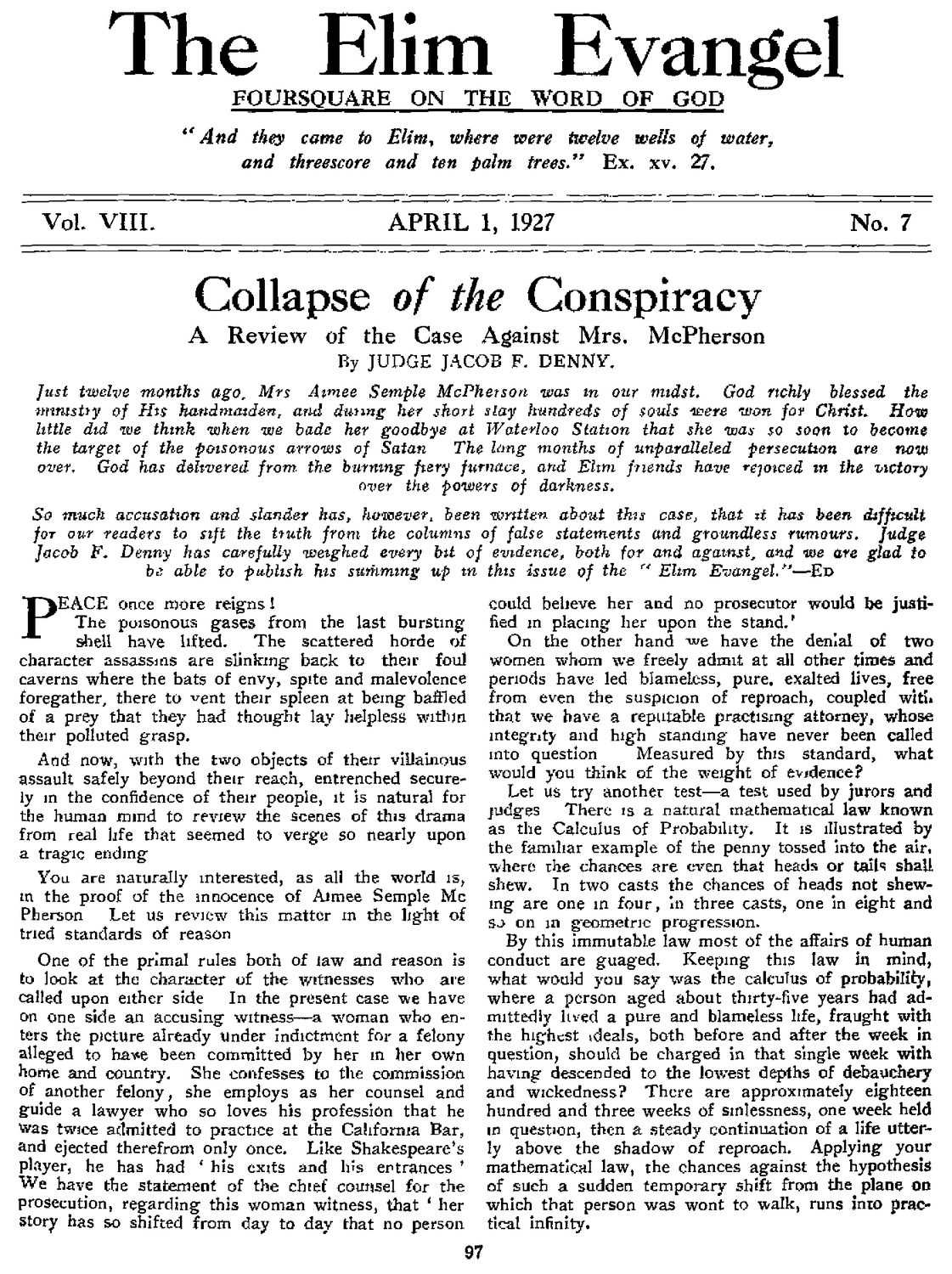
The Elim Evangel, Vol. VIII, No. 7 (1 April 1927), pp. 97–99.
Just twelve months ago, Mrs. Aimee Semple McPherson was in our midst. God richly blessed the ministry of His handmaiden, and during her short stay hundreds of souls were won for Christ. How little did we think when we bade her goodbye at Waterloo Station that she was so soon to become the target of the poisonous arrows of Satan. The long months of unparalleled persecution are now over. God has delivered from the burning fiery furnace, and Elim friends have rejoiced in the victory over the powers of darkness. So much accusation and slander has, however, been written about this case, that it has been difficult for our readers to sift the truth from the columns of false statements and groundless rumours. Judge Jacob F. Denny has carefully weighed every bit of evidence, both for and against, and we are glad to be able to publish his summing up in this issue of the "Elim Evangel."—Ed.
Peace once more reigns! The poisonous gases from the last bursting shell have lifted. The scattered horde of character assassins are slinking back to their foul caverns where the bats of envy, spite and malevolence foregather, there to vent their spleen at being baffled of a prey that they had thought lay helpless within their polluted grasp.
And now, with the two objects of their villainous assault safely beyond their reach, entrenched securely in the confidence of their people, it is natural for the human mind to review the scenes of this drama from real life that seemed to verge so nearly upon a tragic ending.
You are naturally interested, as all the world is, in the proof of the innocence of Aimee Semple McPherson. Let us review this matter in the light of tried standards of reason.
One of the primal rules both of law and reason is to look at the character of the witnesses who are called upon either side. In the present case we have on one side an accusing witness—a woman who enters the picture already under indictment for a felony alleged to have been committed by her in her own home and country. She confesses to the commission of another felony, she employs as her counsel and guide a lawyer who so loves his profession that he was twice admitted to practice at the California Bar, and ejected therefrom only once. Like Shakespeare's player, he has had "his exits and his entrances." We have the statement of the chief counsel for the prosecution, regarding this woman witness, that "her story has so shifted from day to day that no person could believe her and no prosecutor would be justified in placing her upon the stand."
On the other hand we have the denial of two women whom we freely admit at all other times and periods have led blameless, pure, exalted lives, free from even the suspicion of reproach, coupled with that we have a reputable practising attorney, whose integrity and high standing have never been called into question. Measured by this standard, what would you think of the weight of evidence?
Let us try another test—a test used by jurors and judges. There is a natural mathematical law known as the Calculus of Probability. It is illustrated by the familiar example of the penny tossed into the air, where the chances are even that heads or tails shall shew. In two casts the chances of heads not shewing are one in four, in three casts, one in eight and so on in geometric progression.
By this immutable law most of the affairs of human conduct are gauged. Keeping this law in mind, what would you say was the calculus of probability, where a person aged about thirty-five years had admittedly lived a pure and blameless life, fraught with the highest ideals, both before and after the week in question, should be charged in that single week with having descended to the lowest depths of debauchery and wickedness? There are approximately eighteen hundred and three weeks of sinlessness, one week held in question, then a steady continuation of a life utterly above the shadow of reproach. Applying your mathematical law, the chances against the hypothesis of such a sudden temporary shift from the plane on which that person was wont to walk, runs into practical infinity.
There is another natural law that safeguards the innocent and confuses the guilty. It is that no two facts are at war with each other and that no lie will fit any fact unless it is built to dovetail with it; and then is thrown out of joint the normal sequence at each end of the false structure, so that new lies are called for to bolster up the old, and finally the inevitable head-on collision occurs between an uncontrovertible fact and a patent falsehood. Then the whole fabric of lies falls to the ground.
This natural law saved Aimee Semple McPherson! Her simple story of her abduction, convincing and plausible, she was required to narrate many times and never did it in any way to conflict with itself or with any outside fact. But finally the story of her would-be destroyers, builded upon falsehood, changed from day to day until no one could place any faith in its credibility.
Regarding the subject of motive, if this woman had so far rung false to the whole tenor of her beautiful life that she wanted to slink off for a few weeks and descend to the very charnel house of iniquity, need she have concocted any wild tale of kidnapping or mysterious disappearance to have done so? She was mistress of her own actions and her own will would have been law without making any explanation at all. Her people would have gladly given her a trip around the world if she but expressed a desire for it.
Was it to gain notoriety? Angelus Temple, the largest church auditorium in the greatest city west of the Mississippi River, was too small to hold the throngs that nightly beat about its doors, anxious to catch an occasional word or a sight of this Evangelist. Her name was known and held in reverence upon every continent of earth. What had she further to gain in that regard?
Another rule of evidence, far older than English jurisprudence itself, is the one against the reception of hearsay. Never was the wisdom of this doctrine made more apparent than in the McPherson case. A certain chain of newspapers, not particularly famed for being over-scrupulous, undertook to stir up public clamour against Mrs. McPherson. Every few minutes extras would be published to record a rumour that a hair had been found in New York City that might be from the head of the Evangelist. Fifteen minutes later another flaming extra announced that renowned experts were preparing to measure the diameter of this hair as a means of identity. A little later another extra said, "Rumour that Mrs. McPherson is going to flee from Los Angeles."
Always they would preface their foul insinuations with the safeguarding words, "It is rumoured." And within the hour they could shew it was rumoured, for they themselves were the industrious starters and circulators of these same tales which they would repeat over and over again as though they were accepted and admitted truths.
Scores of secret service sleuths were unleashed upon the trail, and each day they would give to the eager newspapers the result of their findings or the state of their suspicions. Always conjecture was blended with any trivial fact discovered and always that conjecture was bent in favour of the guilt of the defendants. From as many states as there were in the original federation, hotel registers were brought and poured over by professed experts. The State of California, with all her storehouse of treasure, its mighty governmental resource, was tapped and drained like an irrigation dam to deluge the defendants beneath an avalanche of filthy waters. The organization of the Federal Government at one time was said to have joined in this investigation.
Against all this mighty array there stood two lone women, terrified, it is true, at the mighty forces that were clamouring for their undoing, but brave as lions in the consciousness of their innocence. No word came from them in their defence, for they were advised by their counsel that the place to try lawsuits was in the courts and not in the newspapers.
The cheap clowns of vaudeville, ever ready to cater to the responsive in their audiences, however grovelling that taste might be, exhausted their puny wits in trying to bring from their jaded listeners a laugh at the expense of these persecuted women and bring further reproach upon their fair names.
Some power, greater than human force, greater than human understanding, put all of their efforts to naught; and those two names, Sister McPherson and Mother Kennedy, stand to-day respected, revered and beloved.
Unquestionably at one time a goodly portion of the careless public were taking for granted the loose conjecture based on "what they say." But finally, without any gun being fired on the part of the defense, they began to ask:
What person affirms the truth of these awful charges? What is there improbable about her story of abduction? Are there no criminals in Los Angeles or vicinity capable of committing the crime of kidnapping for any one of a dozen motives?
Then the newspapers played their last card. According to their own statement, at their own expense they brought from the far east the man whose name had been bandied about for months. They maintained a watchful guardianship over him so that he might not be approached by any friend of the defendants. He was subjected to that last resort of governmental power desperately grasping for evidence against a defendant. He was indicted so that he might figure. Now, if I tell the truth I may end at San Quentin; but if I testify against the principal defendant, I can go free. To his credit let this be said, no power, prestige or gold tempted him to involve the innocent in his own freely confessed wrong-doing.
For the most part the clergy of Los Angeles displayed that spirit of dignified courtesy and fairness that is becoming to their high calling. But from the sub-strata of the clergy arose a class of moral lepers, who frantically strove to get into the McPherson picture. Their own pews were vacant and they read with bitter envy of the unparalleled multitudes that nightly crowded Angelus Temple and which even all this conspiracy of destruction could not stem, even when it was at its very height. Some of them even hired a hall and called a meeting in the name of the ministry and sought to strut out an hour of the publicity for which they so longed. If they could only get their names in print along with these two women, they would feel they had accomplished something. They were not over successful at this, however.
Then, when every resource had been exhausted, when the last report of the array of "experts" and "sleuths" had been made, every "clue," however remote, had been run down, after an investigation lasting more than six months and occupying the attention from first to last of hundreds of agents, the great State of California announced to the court and to the world:
"We have weighed our case in the balance and it has been found wanting! We have no charge to make against these women."
How sweeping an exoneration!
Not an acquittal by a jury of unprejudiced men who had heard the evidence and decided in the light of the presumption of innocence that they could not find sufficient evidence; but a finding by the very enemies of the defendants that they were unable to produce enough evidence in any manner to substantiate their ungrounded charges!
Still one who holds himself out to the public as a minister of a Christian church is frantically trying to break into the picture and blow the breath of life into the putrid corpse of slander which is dead and discredited, never to rise again.
Whose was the master hand that conceived this gigantic plot against these women? We frankly say we do not know any more than the world has ever known who were the criminal abductors of Charley Ross so long ago. What was their motive? We do not know. We know that Mrs. McPherson's fearless attacks from the pulpit and over radioland upon the shameless violations of law and morality could not have been received in any very amicable spirit by those whose entire fortunes were tied up in and dependent upon the perpetuation of certain forms of vice. We know that in the instances referred to there were some so-called ministers whose jealousy of Mrs. McPherson's superior achievements in the evangelistic field were gall and wormwood to their souls, and her rebuke of the backslidden church may explain their antagonistic attitude.
We do not accuse anyone, for we do not know.