Harry Chandler: The Man Behind the Campaign Against Aimee Semple McPherson
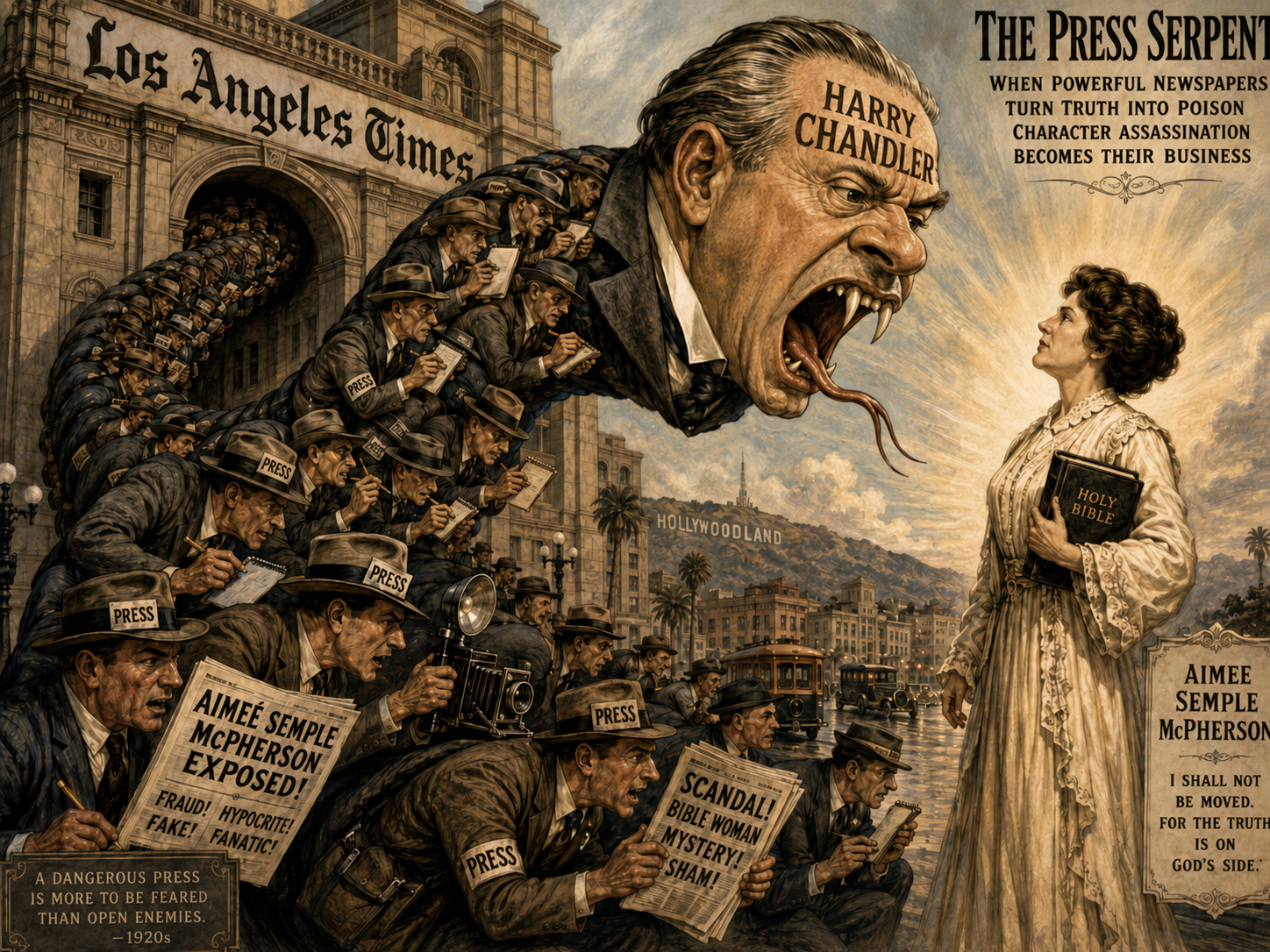
The Publisher, the Radio Rivalry, and the Destroyed Files Behind Los Angeles’S Most Enduring Religious Scandal
Harry Chandler never had to stand at a courtroom lectern and accuse Aimee Semple McPherson himself. He owned the machinery that did it for him.
As publisher of the Los Angeles Times, Chandler presided over a newspaper that did not merely describe Los Angeles. It promoted favored interests, attacked selected opponents, shaped political outcomes and helped determine which version of public events the city would accept.
In 1926, that machinery turned upon Aimee Semple McPherson.
The surviving evidence does not yet include a signed Chandler order directing reporters to destroy her reputation. Chandler made certain that such private evidence would be difficult to find: by his direction, all his personal and business files were burned after his death. What survives is the public pattern.
Aimee had separated herself from the Times’ broadcasting operation, built a powerful station of her own and hired away one of KHJ’s best-known radio engineers. When she disappeared and returned with an account of kidnapping and escape, the Times did not behave as a detached newspaper. Its reporters helped pursue witnesses and develop the alternative story that she had spent the missing weeks with her married engineer, Kenneth G. Ormiston.
THAT ACCUSATION STRUCK BOTH DEFECTORS AT ONCE.
Ormiston became the adulterous fugitive who had abandoned the Chandler radio operation. Aimee became the religious hypocrite who had supposedly fabricated a kidnapping to conceal an affair with him.
Whether Chandler personally designed every feature of that attack cannot now be proved from his missing files. But the campaign occurred under his authority, through an institution he controlled and in a manner entirely consistent with the way he used the Los Angeles Times against other people who crossed the interests of the Chandler establishment.
Harry Chandler Was Not an Ordinary Newspaper Publisher
Harry Chandler became publisher of the Los Angeles Times after the death of his father-in-law, Harrison Gray Otis, in 1917. By the time of Aimee’s disappearance in 1926, Chandler had spent decades learning how to combine newspaper influence, business interests, political alliances and land development.
He was not simply an editor concerned with headlines and circulation. Chandler organized syndicates, acquired enormous tracts of land and became one of the most powerful private figures in Southern California.
The Los Angeles Times’ own later history describes Chandler as ambitious and ruthless, with his opinions tied closely to his business interests. PBS SoCal’s history of the family similarly concludes that Chandler used the newspaper to attack enemies and promote his commercial interests.
The family newspaper functioned as an instrument of power long before modern ideas of editorial independence took hold at the Times. A later PBS history observed that the paper had traditionally promoted both the growth of Los Angeles and the Chandler family’s real-estate investments rather than placing journalistic neutrality first. Chandler himself expressed the relationship plainly in 1934:
“The best interests of Los Angeles are paramount to the Times.”
The deeper question, of course, was who decided what those interests were. For much of the Chandler era, the answer was the family controlling the newspaper.
The Times was Accustomed to Making Enemies
The newspaper culture Harry Chandler inherited from Otis was openly combative. The Times did not merely disagree with opponents. It attacked their character, questioned their loyalty, assigned inflammatory labels and used repeated publication to wear down resistance. Historical accounts describe an institution in which the owners’ political and commercial opponents could be treated as enemies of the city itself.
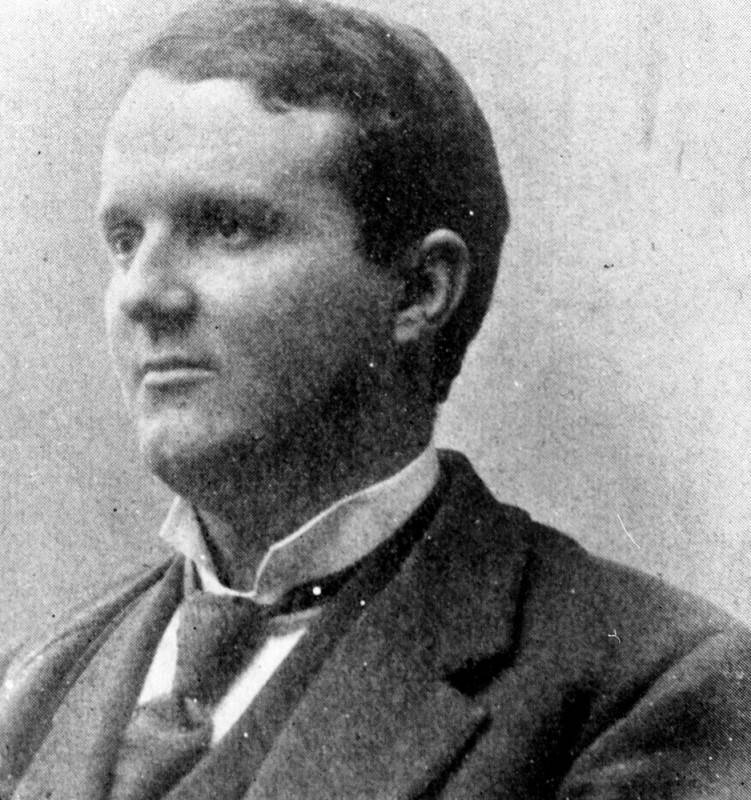
Under Harry Chandler, the newspaper remained a partisan and booster-driven enterprise. Its later transformation into a nationally respected journalistic institution would not begin until his grandson Otis Chandler became publisher in 1960. The Times’ own retrospective history acknowledges that the earlier paper served as a tool for marketing Los Angeles, opposing unions and extending the family’s economic reach.
When the Chandler-controlled Times considered a person or movement useful, the paper could promote it. When an interest became troublesome, independent or threatening, the same newspaper possessed the resources to discredit it.
Chandler and Aimee Did Not Begin as Enemies
The relationship between Aimee and the Times was initially cooperative. Before she built KFSG, Aimee gained broadcasting experience through occasional appearances on KHJ, the radio station associated with the Los Angeles Times. KHJ donated Sunday airtime to Protestant ministers, and Aimee’s experience there helped convince her of radio’s power to extend her ministry.
When KFSG opened on February 6, 1924, the Times treated it as a major event. Radio historian Jim Hilliker reports that the launch became the newspaper’s principal front-page story the next day.
Harry Chandler himself participated in the dedicatory program and congratulated Angelus Temple on its new broadcasting equipment. KHJ announcer “Uncle John” Daggett also appeared. Chandler initially recognized Aimee as a valuable Los Angeles religious figure and broadcasting attraction.
Aimee Left Chandler Broadcasting System
Aimee did not remain a guest on KHJ. She established her own station at Angelus Temple, financed by her congregation and supported by listeners. KFSG gave her direct access to the public without needing a newspaper, commercial station, or secular media owner to approve her message.
To construct and operate the new station, she hired Kenneth Gladstone Ormiston away from KHJ. Ormiston had not been an anonymous technician. He had worked at the Times’ station, written the newspaper’s radio column, and developed a public reputation as a radio expert.
- Aimee moved from using the Chandler station to owning an independent station.
- Ormiston moved from the Chandler organization to building and operating that competing voice.
KFSG was powerful for its time. Its 500-watt signal equaled the transmission power then used by established Los Angeles stations including KHJ. The station could be heard far beyond the immediate area and broadcast Aimee’s preaching, Temple services, music and appeals without passing through the Times’ editorial or commercial control.
Scandal Narrative Punished Both Who Left
When Aimee disappeared on May 18, 1926, Ormiston had already left his position at Angelus Temple. After Aimee returned and reported that she had been kidnapped, hostile investigators and newspapers promoted a different story: she was with Ormiston at a cottage in Carmel-by-the-Sea. That accusation by the press was devastating.
Ormiston was now:
- an adulterer
- a fugitive
- a deserter from his employment
- and an accomplice in a criminal deception
Aimee was portrayed as:
- an adulteress
- a liar
- a religious fraud
- and the organizer of a fabricated kidnapping
The scandal fused their names so completely that Ormiston’s admitted relationship with an unidentified woman became, in the public mind, evidence that the woman must have been Aimee.
But Ormiston denied that his companion was Aimee. Witnesses disagreed over the woman’s identity, and the physical investigation did not produce Aimee’s fingerprints in the cottage. Nevertheless, the affair narrative accomplished its commercial and institutional purpose, and Chandler got his payback: It disgraced the engineer who had left KHJ and the broadcaster who had taken him.
The Times Did Not Merely Report the Investigation
The most important fact about the Times’ role is that its reporters became part of the evidence-gathering process. A modern Los Angeles Times review acknowledges that when an investigator traveled to Carmel, newspaper reporters followed him and their competition for scoops effectively helped him gather evidence.
The same review describes the affair as a “trial in the press” that pushed forward even while District Attorney Asa Keyes showed reluctance about prosecuting. That admission is crucial. The newspaper was not standing at a safe distance, receiving official reports and informing readers. Reporters pursued witnesses, uncovered supposed evidence, cultivated sources and fed new developments into an atmosphere of public accusation.
Each sensational discovery increased circulation and intensified pressure upon prosecutors. The line between newspaper reporting and criminal investigation became dangerously thin. The press did not have to prove beyond a reasonable doubt that Aimee had been in Carmel. It needed only to keep the accusation alive from one edition to the next.
The prosecution, by contrast, eventually had to rely upon witnesses who could survive examination. Its central conspiracy witness, Lorraine Wiseman-Sielaff, changed her account repeatedly until Keyes admitted that no prosecutor could vouch for her credibility. The charges were dismissed before the scheduled jury trial.
The newspaper had already achieved what the courtroom never did. It had successfully attached the word “hoax” to Aimee’s name.
A Publisher Cannot Disappear Behind His Reporters
It would be unreasonable to treat Harry Chandler as unrelated to the sustained behavior of the newspaper he controlled. The Times was not an autonomous public institution operating independently of its owner’s priorities. Historical accounts repeatedly describe Harry Chandler using the paper to pursue business interests, political objectives and personal causes. The Times operated within a culture he inherited, preserved and directed.
The public attack upon Aimee unfolded through Chandler’s newspaper, under Chandler’s authority, using personnel and resources for which Chandler was responsible. That is not guilt by association. It's the ordinary meaning of ownership and command.
The Evidence That Could Settle the Question Was Burned
Harry Chandler died on September 23, 1944. By his order, all his personal and business files were burned. PBS SoCal’s history of the Los Angeles Times states this directly. Chandler’s great-grandson later confirmed that he had destroyed his papers and described Harry and Marian Chandler as intensely private people.
The destruction reportedly may also have consumed private papers belonging to his father-in-law, Harrison Gray Otis. This loss had direct consequences for the Aimee investigation. Chandler’s private files most likely contained:
- communications with editors
- instructions concerning coverage
- correspondence with prosecutors and investigators
- discussions of KHJ and KFSG
- reactions to Ormiston’s departure
- circulation strategies
- and private assessments of Aimee
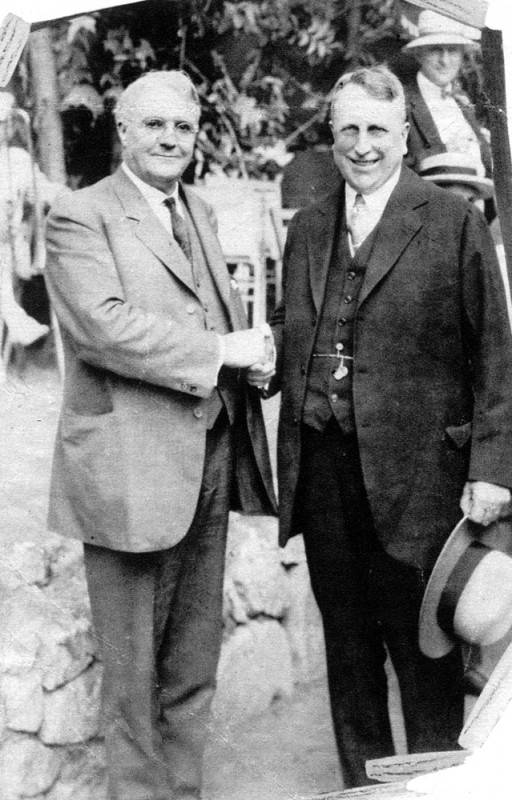
Masonic Ties
The following image shows Chandler and W. R. Hearst (odd handshake). Chandler was more powerful than Hearst in the Los Angeles area and even held the mortgage of Hearst's mansion when he went bankrupt.