
Fact-checking Dorothy Fortenberry’s Review of Claire Hoffman’s Sister, Sinner
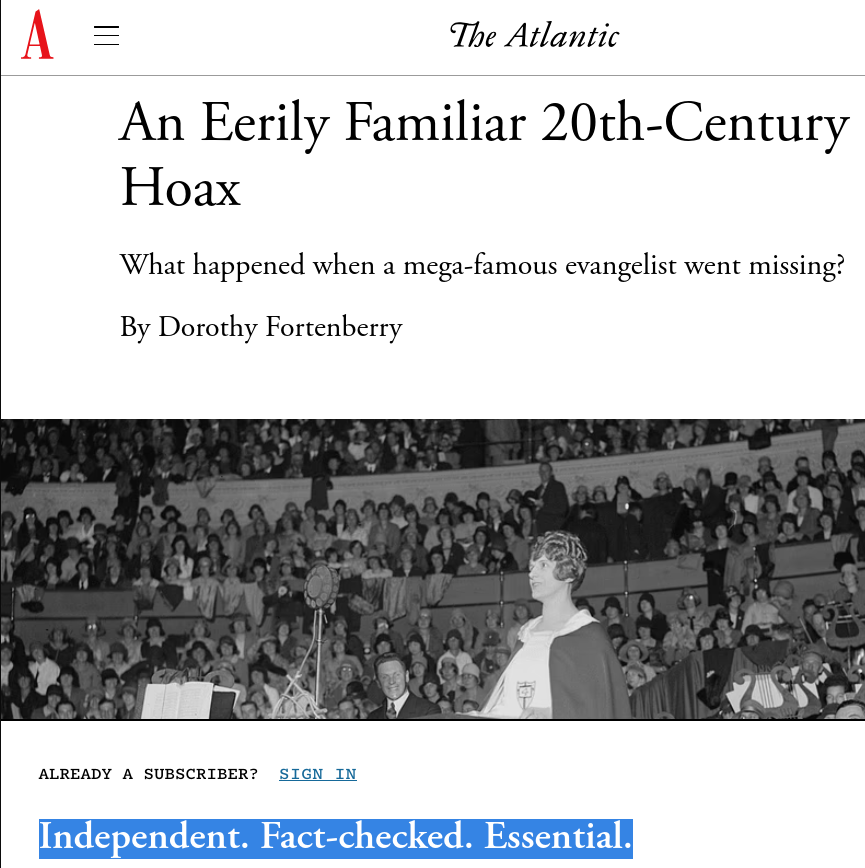
Article reviewed: “An Eerily Familiar 20th-Century Hoax”
Author: Dorothy Fortenberry
Publication: The Atlantic
Published: May 12, 2025
Link: theatlantic.com/books/archive/2025/05/sister-sinner-aimee-semple-mcpherson-book-review/682770/
The verdict appears before the evidence.
The Atlantic’s headline calls Aimee Semple McPherson’s 1926 kidnapping a hoax. The opening paragraphs compare her with two modern women whose false kidnapping stories were proved through criminal proceedings. The review then calls Aimee’s disappearance a stunt, describes her captors as invented, accuses her of exploiting anti-Latino prejudice and faults biographer Claire Hoffman for declining to condemn her.
At no point does the article establish that Aimee fabricated her kidnapping.
It does something much easier: it assumes guilt, removes the evidence supporting her account and then criticizes Hoffman for not expressing the same certainty.
The Atlantic article is therefore not a balanced examination of a disputed historical event. It is a modern continuation of the trial by newspaper that began in Los Angeles in 1926.
Central Claims at a Glance
The Atlantic claims: Aimee’s kidnapping was a hoax.
The record shows: She never confessed, never recanted, was never tried by a jury and was never convicted. The prosecution abandoned its case when its principal conspiracy witness became impossible to defend.
The Atlantic claims: Aimee invented a Latino couple named Felipe and Mexicali Rose.
The record shows: Contemporary accounts say Aimee described three American captors. Felipe was not one of the couple who approached her on the beach. He was a man to whom her captors allegedly discussed selling her.
The Atlantic claims: Witnesses placed Aimee with Kenneth Ormiston at Carmel.
The record shows: Witnesses contradicted one another, several people who saw Ormiston’s companion said she was not Aimee, and no fingerprints belonging to Aimee were found in the cottage.
The Atlantic claims: Her disappearance was a stunt whose consequences included two deaths.
The record shows: The deaths occurred because those searching for Aimee believed she had drowned. They do not prove that she staged her disappearance.
The Atlantic claims: Hoffman should have been more willing to condemn Aimee.
The record shows: Condemnation is not a substitute for historical proof.
Headline Announces a Verdict History Never Reached
The headline—“An Eerily Familiar 20th-Century Hoax”—does not identify the hoax allegation as a theory. It presents it as an established event.
The opening continues in the same manner. Aimee is said to have returned with a “sordid” abduction account. Her captors are called invented characters. The disappearance is repeatedly described as a hoax and later as a stunt.
These are not neutral descriptions. They are findings of guilt.
Yet no court ever found that Aimee staged her kidnapping. She never admitted doing so. Kenneth Ormiston admitted that he had been with another woman but repeatedly denied that the woman was Aimee. The criminal charges were dismissed before the scheduled jury trial took place. Even the Smithsonian’s skeptical account concludes that the kidnapping and the competing hoax theory remained unresolved.
The Atlantic is entitled to argue that the hoax theory is persuasive. It is not entitled to convert an accusation into a fact without presenting the evidence necessary to sustain that conclusion.
Comparison With Katie Sorensen is Fundamentally Dishonest
Fortenberry begins with Katie Sorensen, a California social-media personality who falsely accused a Latino couple of attempting to kidnap her children.
Sorensen’s account was investigated. The accused couple had not attempted to take her children. Sorensen was prosecuted and convicted of filing a false report.
The review then declares Aimee’s case a similar incident.
It was not.
Aimee never confessed. She was never convicted. Her kidnapping account was not disproved by a video recording, an admission or a criminal verdict. She maintained it until her death eighteen years later.
The review later invokes Sherri Papini, who admitted fabricating her kidnapping and pleaded guilty to federal charges. The article itself acknowledges Papini’s guilty plea and prison sentence.
Thus, the comparison is:
- one woman convicted of making a false report;
- one woman who confessed and pleaded guilty;
- and Aimee, who neither confessed nor was convicted.
Those are not legally or historically equivalent cases.
The analogy works only if the reader accepts Aimee’s guilt before examining the evidence. That is precisely what the headline instructs the reader to do.
“Latino Couple” Claim is Factually Wrong
The most serious factual error appears near the beginning of the article.
Fortenberry writes that Aimee blamed the kidnapping on a Latino couple consisting of Felipe and Mexicali Rose. She then builds an accusation of racial exploitation upon that assertion.
But that was not Aimee’s account.
A contemporary 1926 report summarized Aimee’s description of two men and a woman holding her. One man was called Steve, and the woman was called Rose. The two men allegedly discussed selling Aimee to a man named Felipe. Felipe was not identified as the man who approached her at the beach, nor as Rose’s partner in the supposed couple.
The Smithsonian’s reconstruction of Aimee’s first bedside interview says that she described her captors as three Americans, including Steve and Rose.
The Atlantic changes that account in two crucial ways:
First, it moves Felipe from the position of a prospective buyer mentioned by the captors into the role of an actual kidnapper.
Second, it labels the captors a Latino couple even though Aimee’s first account described the three captors as Americans.
The article then accuses her of having “weaponized anti-Latino racism.”
That accusation is built upon the article’s own inaccurate reconstruction of her story.
There may be a legitimate historical discussion about how American newspapers racialized the Mexican border, repeated stereotypes and popularized the name “Mexicali Rose.” But before assigning that conduct to Aimee personally, a writer must distinguish:
- what Aimee actually said;
- what police or reporters inferred;
- what newspapers added;
- and what later authors repeated.
The Atlantic does none of that. It creates a Latino couple, attributes the construction to Aimee and then condemns her for it.
Review Omits the Independent Witnesses Who Found Aimee
Aimee did not reappear at Angelus Temple surrounded by associates who could prepare or coach her.
She emerged near Agua Prieta, Mexico, in the early morning and collapsed at the home of Ramón and Teresa González. They did not initially know who she was.
Ramón González later gave a sworn account stating that the unknown woman entered his home in an excited condition, left while he was dressing and was found lying unconscious or fainted at the gate. González said she was cold and that he initially thought she was dead. He and his wife carried her inside before arranging transportation to Douglas, Arizona.
Douglas police officer G. W. Cook likewise swore that she appeared to be in a state of complete physical exhaustion when she arrived at the police station. He immediately had her taken to the hospital. Cook also examined her clothing and shoes and inspected the country east of Agua Prieta. He concluded that the condition of her clothing was compatible with walking through that terrain.
A modern Arizona history likewise records that Aimee collapsed at the González home and was taken across the border before local people understood that the exhausted stranger was the missing evangelist.
These were independent witnesses. They encountered Aimee before her mother, children, attorneys or Angelus Temple staff arrived.
The Atlantic mentions none of them.
That omission allows the review to present Aimee’s reappearance as a dramatic performance instead of an event witnessed by people who had no established connection to her ministry.
Constable Ash Directly Answered the Newspaper Objections
Constable O. A. Ash of Douglas is one of the most important witnesses omitted from modern retellings.
Ash personally examined the evidence surrounding Aimee’s return. He reported seeing marks on her wrists, swelling around her ankles, holes in her stockings and damage to her dress.
He also challenged the distorted geography published by hostile newspapers. Reports had described a nearly impossible march through burning sand, extreme heat and clothing-destroying vegetation. Ash backtracked the relevant terrain and described grassland, pasture and available springs rather than the waterless furnace presented to Los Angeles readers.
Several months after Aimee’s escape, Ash also reported the discovery of a miner’s cabin near an abandoned mine roughly eighteen miles from Douglas. Inside was an opened oil can with a rough edge and strips cut from bed ticking. Ash connected those objects with Aimee’s account of having been bound and of cutting herself free.
We have traced Ash’s interview to its original publication in the Redlands Daily Facts, rather than merely relying upon the later Madera Tribune reprint cited in online histories.
Ash’s evidence matters because it directly answers several claims used to ridicule Aimee:
- that no restraint marks existed;
- that her ankles and feet showed no hardship;
- that her clothing was inconsistent with the terrain;
- that the journey was physically impossible;
- and that no location or physical evidence corresponding with the cabin was ever found.
The Atlantic does not examine Ash and disagree with him.
It simply leaves him out.
Carmel Evidence Was Contested—Not Conclusive
The review says that prosecutors found witnesses who reported seeing Aimee with Ormiston at a secluded cottage in Carmel.
That statement is technically incomplete to the point of distortion.
Some witnesses said the woman resembled Aimee. Others said she did not. A Los Angeles Times review of Hoffman’s book concedes that the witnesses divided on the identification.
The descriptions also conflicted. Ormiston’s companion was variously described as younger than Aimee, blonde, dark-haired, fair-skinned, olive-complexioned or more than forty years old.
William McMichaels, who worked near the property and saw the woman repeatedly at close range, said Aimee was not the woman he had observed. Carmel town marshal August England, who had spoken with the woman at close range, likewise said she was positively not Aimee. Other witnesses who could not identify Aimee said investigators pressured them to do so.
Most damaging to the certainty of the Carmel theory, investigators dusted the cottage and found no fingerprints matching Aimee.
Ormiston did not deny being there. He acknowledged being accompanied by a woman and admitted an extramarital relationship. He denied that his companion was Aimee.
Evidence that Ormiston committed adultery is not evidence that he committed adultery with Aimee.
The Atlantic collapses all of this into the statement that witnesses reported seeing the pair. It gives the accusation while withholding the contradictions, failed physical evidence and contrary identifications.
Prosecution’s Collapse is Reduced to Four Passive Words
Near the end, Fortenberry says only that the charges were “ultimately dropped.”
That wording conceals the central fact of the legal proceedings: the prosecution’s most important conspiracy witness became unusable.
District Attorney Asa Keyes acknowledged that Lorraine Wiseman-Sielaff had changed her account almost daily following the preliminary hearing. Her story accumulated so many contradictions and inconsistencies that, in Keyes’s words, no prosecutor could vouch for her credibility.
Keyes further admitted that without her testimony, the alleged conspiracy could not be proved. He moved to dismiss the case on January 10, 1927.
A jury trial had been scheduled. It never occurred because the prosecution abandoned the case.
The Atlantic does not tell its readers:
- that the prosecution’s central witness repeatedly changed her story
- that Keyes publicly disavowed her credibility
- that he admitted the alleged conspiracy could not be proved without her
- or that the state never presented its case to a jury
Instead, the article announces the hoax as fact and treats dismissal as an incidental ending.
That is backwards. The failure of the prosecution’s evidence is not a footnote to the story. It is one of the principal facts by which the hoax accusation must be judged.
Deaths During the Search do Not Prove a Stunt
The Atlantic emphasizes that a diver died while searching for Aimee and that a distraught follower drowned herself.
Those deaths were tragic. They should be remembered accurately and respectfully.
But Fortenberry calls them costs of Aimee’s stunt. That conclusion assumes the disappearance was staged—the very assertion the article has not proved.
Aimee did not return from the water and announce that she had drowned. Her secretary lost sight of her. Her mother concluded that she was dead and publicly announced that belief. Searchers, police and followers then acted upon the assumption that she had been lost in the ocean.
If Aimee was kidnapped, as the affirmative evidence indicates, then the searchers were responding to a tragic but understandable mistake about what had happened to her.
The deaths do not establish where Aimee was. They do not place her in Carmel. They do not identify Ormiston’s companion. They do not disprove the González and Cook affidavits, Ash’s observations or the physical evidence supporting her account.
Using the deaths as proof of moral guilt is an emotional appeal, not historical evidence.
Article Puts its Own Verdict into Aimee’s Mouth
The Atlantic quotes Aimee saying:
“Either I am a good woman, or I am the most terrible, unspeakable person in the whole world.”
But Fortenberry introduces this as a statement Aimee made about how the press treated her “with regard to the hoax.”
That phrasing quietly turns the accusation into a fact before the quotation begins. Aimee was not discussing an admitted hoax. She was discussing the press campaign accusing her of adultery, fraud and criminal conspiracy.
Her point was accurate. The press had created two incompatible versions of her:
- the truthful victim of a kidnapping;
- or a religious impostor who staged an elaborate crime to conceal adultery.
There was no comfortable halfway position between those allegations.
Fortenberry insists that there was a halfway ground and criticizes Hoffman for failing to find it. But a halfway ground cannot be manufactured merely to satisfy a reviewer’s desire for moral ambiguity.
Either Aimee was kidnapped, or she participated in an enormous criminal deception. Those propositions cannot both be partly true.
Demand for “More Opinion” Reveals the Problem
Fortenberry’s final complaint is that Hoffman refuses to condemn Aimee.
The reviewer concludes that writers should be more opinionated.
That sentence reveals the weakness of the entire article.
Hoffman is criticized not for misquoting a document, overlooking a witness or misstating a court finding, but for declining to issue the verdict Fortenberry wanted. The reviewer treats moral condemnation as the missing ingredient.
But the duty of a historian or biographer is not to fill evidentiary gaps with attitude.
The proper questions are:
- What did the witnesses say?
- Which witnesses remained credible?
- What physical evidence existed?
- What evidence failed?
- What did investigators establish?
- What did the prosecution admit it could not prove?
Opinion comes after those questions, not instead of them.
The Atlantic reverses that order. It begins with “hoax,” selects facts that fit that verdict and then faults Hoffman for retaining caution.
“Proto-Influencer” Framing Trivializes Aimee’s Actual Work
The review repeatedly interprets Aimee as an early social-media influencer: relatable, brand-conscious and skilled at making followers feel personally connected.
Aimee unquestionably understood communication. She used print, radio, visual illustration and public events with extraordinary effectiveness.
But reducing her ministry to influence, branding and audience cultivation removes the belief that animated it.
Aimee did not understand herself primarily as a celebrity producing content. She understood herself as an evangelist called to preach Jesus Christ, pray for the sick, provide relief to the poor and proclaim the Foursquare Gospel.
Her influence produced institutions:
- Angelus Temple
- KFSG radio
- a Bible college
- a denomination
- extensive publishing
- missionary work
- and one of Los Angeles’s largest charitable relief operations during the Depression
Even skeptical historical treatments acknowledge the scale of her relief work and the lasting international church she founded.
Calling her a proto-influencer may create a clever modern analogy. It does not adequately explain her life.
“Independent. Fact-checked. Essential.”
At the bottom of its website, The Atlantic describes its journalism with three words:
“Independent. Fact-checked. Essential.”
That standard should apply to its treatment of Aimee Semple McPherson.
A fact-checked article should not describe a disputed kidnapping as a proven hoax without establishing the evidence.
It should not transform Felipe into one of Aimee’s captors when contemporary accounts placed him in a different role.
It should not describe the alleged kidnappers as a Latino couple while omitting reports that Aimee identified three American captors.
It should not mention witnesses who supposedly placed Aimee at Carmel without also reporting the witnesses who said Ormiston’s companion was not Aimee.
It should not omit the failure to find Aimee’s fingerprints in the cottage.
It should not erase Ramón and Teresa González, Officer G. W. Cook, Constable O. A. Ash, Aimee’s physical condition, the restraint marks, the escape terrain, and the evidence found in the miner’s cabin.
It should not say merely that the charges were “dropped” while withholding the district attorney’s admission that his central witness had become so contradictory that no prosecutor could vouch for her.
And an independent article should examine whether the old newspaper campaign possessed commercial, institutional, and personal motives of its own—not simply adopt its conclusions a century later.
The slogan is admirable.
This review did not meet it.
It was not adequately fact-checked because it repeated factual errors and omitted decisive contrary evidence.
It was not independent because it inherited the framing of Aimee’s original accusers.
And it was not essential because it added another confident accusation to a historical record already crowded with them.
What would have been essential was a genuine reexamination of the evidence.
Conclusion: The Atlantic Repeats the Trial by Press
The Atlantic’s article fails at the point where certainty requires evidence.
It declares a hoax without a confession, conviction or conclusive physical proof.
It compares Aimee with women whose fabrications were legally established.
It falsely turns Felipe and Rose into a Latino kidnapping couple, despite contemporary accounts identifying three American captors and placing Felipe outside that role.
It omits the independent witnesses who found Aimee collapsed.
It omits the affidavits describing her physical exhaustion.
It omits Constable Ash’s observations, his examination of the terrain and the cabin evidence corresponding with her account.
It mentions Carmel witnesses without telling readers that other witnesses rejected the identification and that Aimee’s fingerprints were not found.
It reduces the prosecution’s evidentiary collapse to the passive statement that charges were dropped.
It uses two tragic deaths to create emotional guilt without proving a staged disappearance.
Finally, it demands condemnation where the evidence does not justify it.
The historical record supports a far stronger conclusion than the Atlantic permits:
Aimee Semple McPherson was kidnapped, held against her will and escaped into Agua Prieta. Her physical condition was witnessed before her family reached her. Independent witnesses corroborated her exhaustion. Constable Ash documented injuries and evidence consistent with restraint and escape. The attempt to place her with Kenneth Ormiston depended upon conflicting identifications and produced no matching fingerprints. The prosecution abandoned its case when its central witness became indefensible.
The hoax was never proved.
What has endured for a century is something else: an accusation repeated so often that modern writers feel entitled to call it history.
The Atlantic did not solve Aimee Semple McPherson’s disappearance.
It repeated the verdict of the newspapers that tried her first.