
Advertisement
Aimee McPherson's "authorized" account advertised.

MISCELLANEOUS
[Emphasis ours]
READ Aimee Semple McPherson's own signed story in the February Sunset, the only authorized, personal article by the famous evangelist who has been the subject of so much notoriety during the last six months. Order from your news dealer in advance (on sale January 15) or send 25c to Sunset Magazine, San Francisco. Subscription price, $2.50 per year: 2 years, $4.
Source: Siskiyou News, Volume 50, 20 January 1927, p. 5, col. 5, Classifieds>Miscellaneous
“Foursquare!” Sunset Magazine, v.58 Feb. 1927
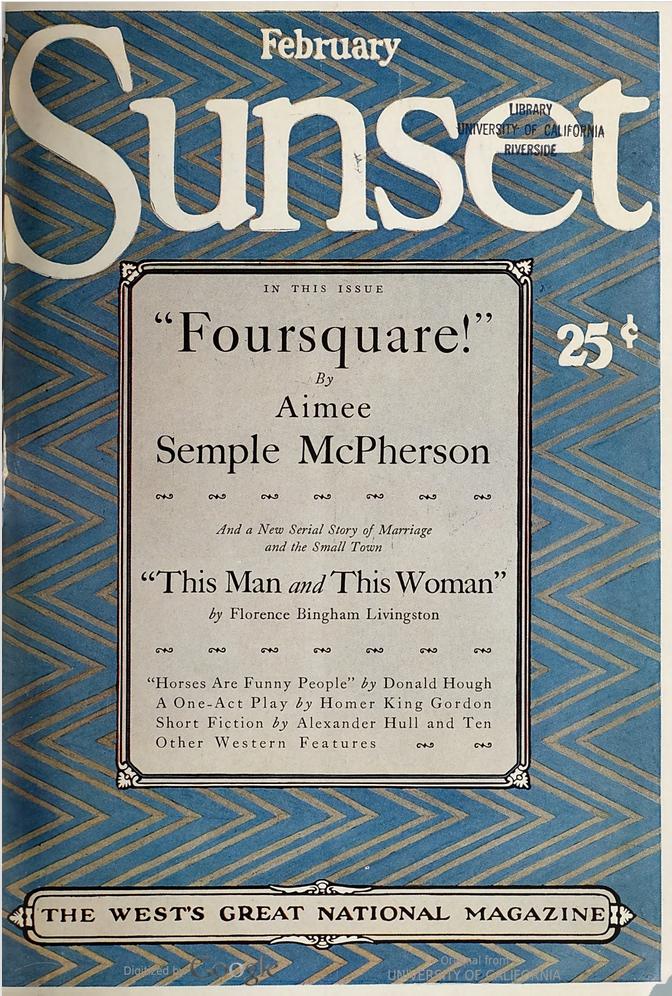
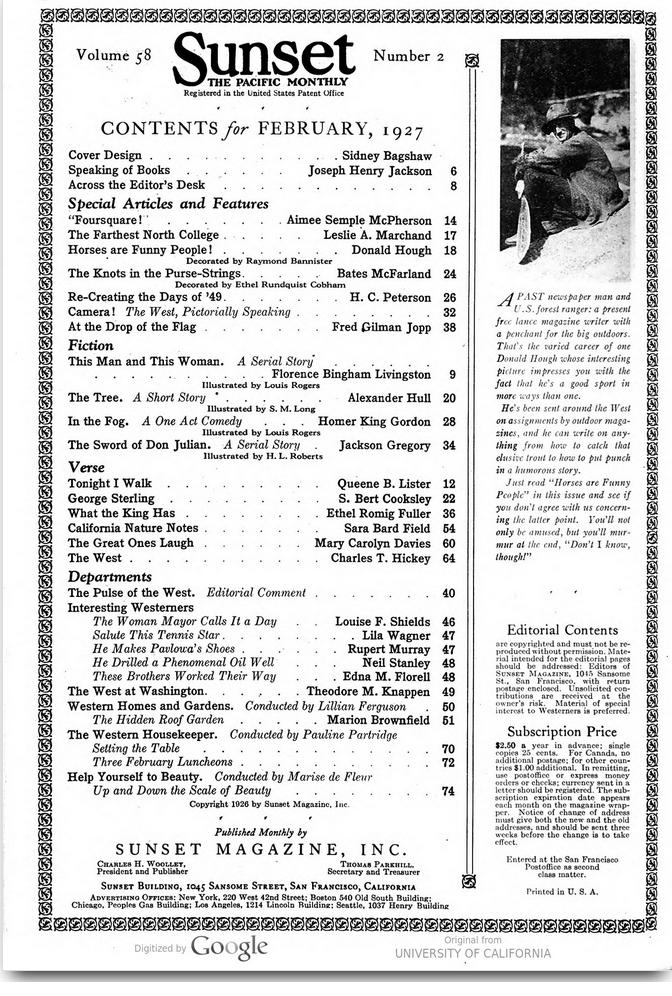
https://babel.hathitrust.org/cgi/ssd?id=uc1.31210004247712
Source: Sunset, The Pacific Monthly, Vol. 58, No. 2 (February 1927), pp. 14–16, 80–82. Digitized from the University of California copy. Public domain.
Transcript
Background (added for this edition)
Aimee Semple McPherson (1890–1944) was among the most famous religious figures in 1920s America. Born in Canada, she built a following as a traveling evangelist before settling in Los Angeles, where on January 1, 1923, she opened the roughly 5,300-seat Angelus Temple, its cornerstone dedicating it "unto the cause of inter-denominational and worldwide evangelism," and intended as an ecumenical center for Christians of every background. An early master of mass media, she staged Hollywood-style "illustrated sermons" — full theatrical productions with sets and props — to draw crowds to the Temple rather than to the city's other amusements, and she ran one of the first church-owned radio stations.
This article appeared in February 1927, just weeks after the legal case against her collapsed. On May 18, 1926, McPherson vanished while swimming near Ocean Park / Venice Beach and was presumed drowned; an enormous search followed. Five weeks later, she reappeared at the Arizona–Mexico border, saying she had been kidnapped, held in a shack near Agua Prieta, and had escaped on foot. Skeptics and much of the press alleged a hoax — that she had spent the weeks with Kenneth Ormiston, a married former radio engineer at the Temple—yet much of the evidence cut in her favor. The Douglas, Arizona constable who tracked her, O. A. Ash, located the shack — a miner's cabin at the abandoned San Juan mine, about eighteen miles from Douglas — and reported the five-gallon oil can whose cut edge she had used to free the cloth-strip bindings on her wrists and ankles; he also testified that the route was not scorching desert but grassy pasture land at some 5,000 feet, rebutting the press claim that her unscuffed shoes and intact clothing disproved her story. Footprints matching her shoes were found near Agua Prieta. Douglas officials, including the mayor, publicly affirmed her account; a grand jury first declined to charge her; the key adverse witness recanted; and District Attorney Asa Keyes dropped all charges in January 1927. No kidnappers were ever identified, and no part of her account was ever conclusively disproven. She maintained her story for the rest of her life.
That episode is the "sensational events of last summer" the editors allude to, and it is what McPherson is rebutting in the article's closing pages.
On the located shack, the oil can, the bindings, and the terrain: contemporary account of Constable O. A. Ash of Douglas, Arizona, who testified on McPherson's behalf and located the cabin — Madera Tribune, January 18, 1927, reprinting the Angelus Sentinel / San Bernardino Daily Sun interview.
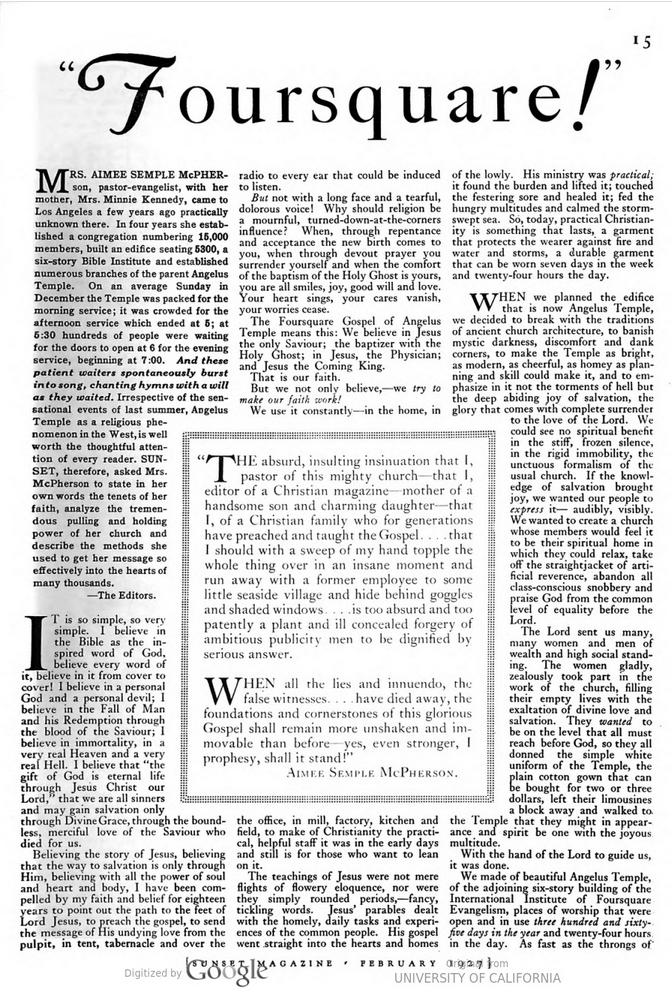
Foursquare!
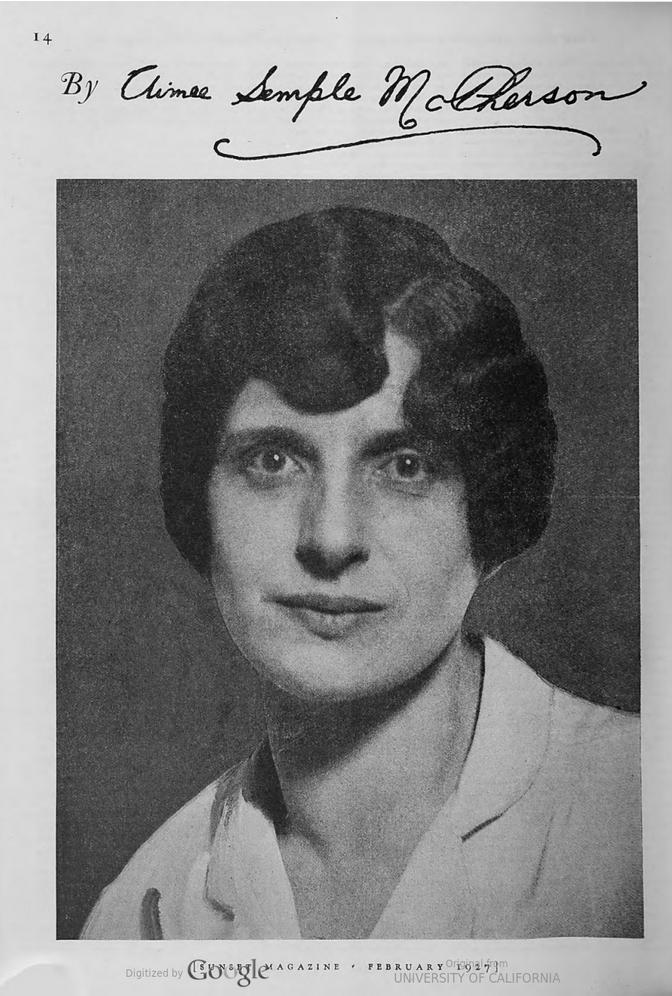
By Aimee Semple McPherson
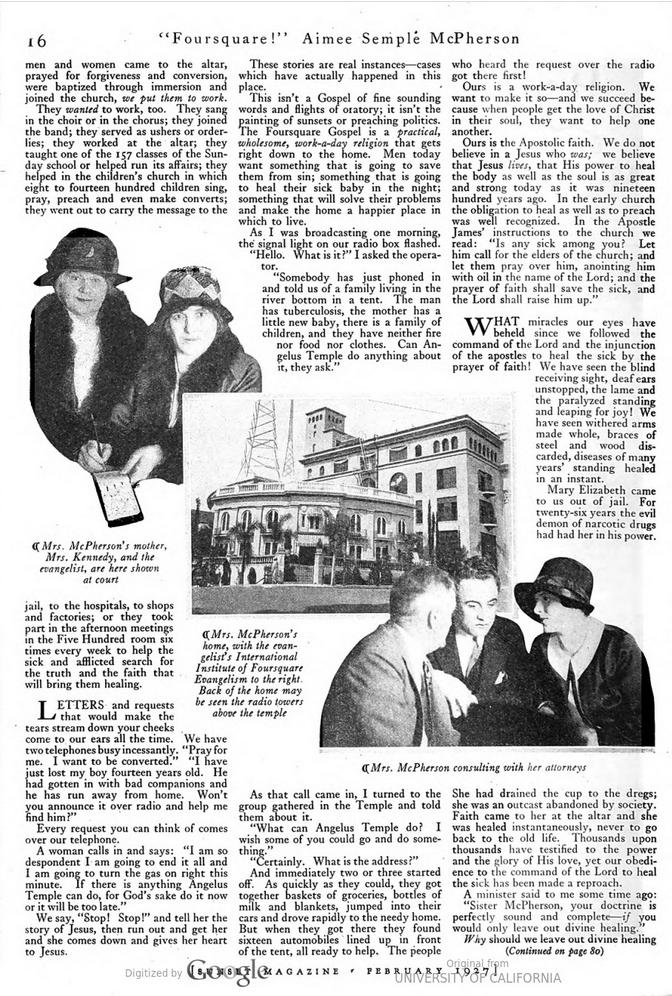
Mrs. Aimee Semple McPherson, pastor-evangelist, with her mother, Mrs. Minnie Kennedy, came to Los Angeles a few years ago, practically unknown there. In four years, she established a congregation numbering 15,000 members, built an edifice seating 5300, a six-story Bible Institute, and established numerous branches of the parent Angelus Temple. On an average Sunday in December, the Temple was packed for the morning service; it was crowded for the afternoon service, which ended at 5:30. Hundreds of people were waiting for the doors to open at 6 for the evening service, beginning at 7:00. And these patient waiters spontaneously burst into song, chanting hymns with a will as they waited. Irrespective of the sensational events of last summer, Angelus Temple, as a religious phenomenon in the West, is well worth the thoughtful attention of every reader. Sunset, therefore, asked Mrs. McPherson to state in her own words the tenets of her faith, analyze the tremendous pulling and holding power of her church, and describe the methods she used to get her message so effectively into the hearts of many thousands.—The Editors.
[Emphasis ours]
It is so simple, so very simple. I believe in the Bible as the inspired word of God, I believe every word of it, believe in it from cover to cover! I believe in a personal God and a personal devil; I believe in the Fall of Man and his Redemption through the blood of the Savior; I believe in immortality, in a very real Heaven and a very real Hell. I believe that "the gift of God is eternal life through Jesus Christ our Lord," that we are all sinners and may gain salvation only through Divine Grace, through the boundless, merciful love of the Savior who died for us.
The absurd, insulting insinuation that I, pastor of this mighty church—that I, editor of a Christian magazine—mother of a handsome son and charming daughter—that I, of a Christian family who for generations have preached and taught the Gospel… that I should with a sweep of my hand topple the whole thing over in an insane moment and run away with a former employee to some little seaside village and hide behind goggles and shaded windows… is too absurd and too patently a plant and ill concealed forgery of ambitious publicity men to be dignified by serious answer.
When all the lies and innuendo, the false witnesses… have died away, the foundations and cornerstones of this glorious Gospel shall remain more unshaken and immovable than before—yes, even stronger, I prophesy, shall it stand!—Aimee Semple McPherson
Believing the story of Jesus, believing that the way to salvation is only through Him, believing with all the power of soul and heart and body, I have been compelled by my faith and belief for eighteen years to point out the path to the feet of Lord Jesus, to preach the Gospel, to send the message of His undying love from the pulpit, in tent, tabernacle and over the radio to every ear that could be induced to listen.
But not with a long face and a tearful, dolorous voice! Why should religion be a mournful, turned-down-at-the-corners influence? When, through repentance and acceptance, the new birth comes to you, when through devout prayer you surrender yourself, and when the comfort of the baptism of the Holy Ghost is yours, you are all smiles, joy, goodwill, and love. Your heart sings, your cares vanish, your worries cease.
The Foursquare Gospel of Angelus Temple means this: We believe in Jesus, the only Savior; the baptizer with the Holy Ghost; in Jesus, the Physician; and in Jesus, the Coming King. That is our faith. But we not only believe—we try to make our faith work!
We use it constantly, in the home, in the office, in the mill, factory, kitchen, and field, to make of Christianity the practical, helpful staff it was in the early days and still is for those who want to lean on it.
The teachings of Jesus were not mere flights of flowery eloquence, nor were they rounded periods, fancy, tickling words. Jesus' parables dealt with the homely, daily tasks and experiences of the common people. His Gospel went straight into the hearts and homes of the lowly. His ministry was practical; it found the burden and lifted it; touched the festering sore and healed it; fed the hungry multitudes and calmed the storm-swept sea. So, today, practical Christianity is something that lasts, a garment that protects the wearer against fire and water and storms, a durable garment that can be worn seven days a week and twenty-four hours a day.
When we planned the edifice that is now Angelus Temple, we decided to break with the traditions of ancient church architecture, to banish mystic darkness, discomfort, and dank corners, to make the Temple as bright, as modern, as cheerful, as homey as planning and skill could make it, and to emphasize in it not the torments of hell but the deep abiding JOY of salvation. This glory comes with complete surrender to the love of the Lord.
We could see no spiritual benefit in the stiff, frozen silence, in the rigid immobility, the unctuous formalism of the usual church. If the knowledge of salvation brought JOY, we wanted our people to express it—audibly, visibly. We wanted to create a church whose members would feel it to be their spiritual home, where they could relax:
- take off the straitjacket of artificial reverence,
- abandon all class-conscious snobbery, and
- praise God from the common level of equality before the Lord.
The Lord sent us many, many women and men of wealth and high social standing. The women gladly, zealously took part in the work of the church, filling their empty lives with the exaltation of divine love and salvation. They wanted to be on the level that all must reach before God, so they all donned the simple white uniform of the Temple, the plain cotton gown that can be bought for two or three dollars, left their limousines a block away, and walked to the Temple that they might, in appearance and spirit, be one with the JOYOUS multitude. With the hand of the Lord to guide us, it was done.
We made of beautiful Angelus Temple, of the adjoining six-story building of the International Institute of Foursquare Evangelism, places of worship that were open and in use three hundred and sixty-five days a year and twenty-four hours a day.
As fast as the throngs of men and women came to the altar, prayed for forgiveness and conversion, were baptized through immersion, and joined the church, we put them to work. They wanted to work, too. They sang in the choir or in the chorus; they joined the band; they served as ushers or orderlies; they worked at the altar; they taught one of the 157 classes of the Sunday school or helped run its affairs; they helped in the children's church in which eight to fourteen hundred children sing, pray, preach, and even make converts.
They went out to carry the message to the jail, to the hospitals, to shops and factories, or they took part in the afternoon meetings in the Five Hundred room six times every week to help the sick and afflicted search for the truth and the faith that will bring them healing.
Letters and requests that would make the tears stream down your cheeks come to our ears all the time. We have two telephones busy incessantly. "Pray for me. I want to be converted." "I have just lost my boy, fourteen years old. He had gotten in with bad companions, and he had run away from home. Won't you announce it over radio and help me find him?"

Every request you can think of comes over our telephone. A woman calls in and says, "I am so despondent, I am going to end it all, and I am going to turn the gas on right this minute. If there is anything Angelus Temple can do, for God's sake, do it now or it will be too late." We say, "Stop! Stop!" and tell her the story of Jesus, then run out and get her, and she comes down and gives her heart to Jesus.
These stories are real instances—cases which have actually happened in this place.
This isn't a Gospel of fine-sounding words and flights of oratory; it isn't the painting of sunsets or preaching politics. The Foursquare Gospel is a practical, wholesome, work-a-day religion that gets right down to the home. Men today want something that will save them from sin; something that will heal their sick baby in the night; something that will solve their problems and make the home a happier place in which to live.
As I was broadcasting one morning, the signal light on our radio box flashed. "Hello. What is it?" I asked the operator.
"Somebody has just phoned in and told us of a family living in the river bottom in a tent. The man has tuberculosis, the mother has a little new baby, there is a family of children, and they have neither fire nor food nor clothes. Can Angelus Temple do anything about it?" They ask.
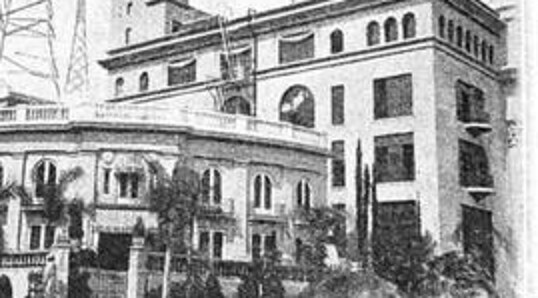
As that call came in, I turned to the group gathered in the Temple and told them about it. "What can Angelus Temple do? I wish some of you could go and do something."
"Certainly. What is the address?"
And immediately two or three started off. As quickly as they could, they gathered baskets of groceries, bottles of milk, and blankets, jumped into their cars, and drove rapidly to the needy's home. But when they got there, they found sixteen automobiles lined up in front of the tent, all ready to help. The people who heard the request over the radio got there first!
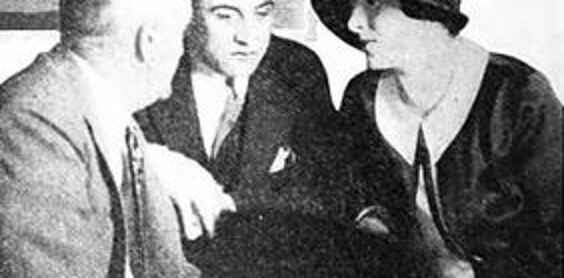
Ours is a workaday religion. We want to make it so, and we succeed because when people get the love of Christ in their souls, they want to help one another. Ours is the Apostolic faith. We do not believe in a Jesus who was; we believe that Jesus lives, that His power to heal the body as well as the soul is as great and strong today as it was nineteen hundred years ago.
In the early church, the obligation to heal as well as to preach was well recognized. In the Apostle James' instructions to the church, we read: "Is any sick among you? Let him call for the elders of the church; and let them pray over him, anointing him with oil in the name of the Lord; and the prayer of faith shall save the sick, and the Lord shall raise him."
What miracles our eyes have beheld since we followed the command of the Lord and the injunction of the apostles to heal the sick by the prayer of faith! We have seen the blind receiving sight, deaf ears unstopped, the lame and the paralyzed standing and leaping for JOY! We have seen withered arms made whole, braces of steel and wood discarded, diseases of many years' standing healed in an instant.
Mary Elizabeth came to us out of jail. For twenty-six years, the evil demon of narcotic drugs had had her in his power. She had drained the cup to the dregs; she was an outcast abandoned by society. Faith came to her at the altar, and she was healed instantaneously, never to go back to the old life. Thousands upon thousands have testified to the power and the glory of His love, yet our obedience to the command of the Lord to heal the sick has been made a reproach.
A minister said to me some time ago: "Sister McPherson, your doctrine is perfectly sound and complete—if you would only leave out divine healing." Why should we leave out divine healing when the scores upon scores of discarded crutches in the Temple testify to the JOY and happiness and faith of the owners who abandoned them, to the present-day glory and the power of the Lord?
Many ministers object to Angelus Temple because its pastor is a woman, because there is no pulpit but a wide platform, and because the pastor does not stand stock still while preaching. After all, the preaching is not done conventionally. After all, the congregation indicates its approval by applause, by frequent exclamations, by raising a forest of arms, by entering into the spirit of the service with zeal and enthusiasm.
Which is the true object of divine service,—the observance of certain conventional forms or the saving of souls? "By their fruits ye shall know them." And, praise the Lord, the harvest of souls and the healing of bodies has been EXCEEDINGLY GREAT in Angelus Temple.
Many objected, even some members of Angelus Temple felt a little uneasy about the novelty of the illustrated sermons every Sunday evening, sermons in which the lesson of the text is driven home through the eye as well as the ear. What matters the trail so long as the goal is reached? If we can hold the wavering attention and reach the heart of just one sinner through the costumes, the scenery, and the properties of the illustrated sermon, the gain is worth all the efforts of the "Construction Gang," the artists and craftsmen who labor often for ten hours at a stretch—all night and half the day—to have the illustrations ready for the service.
I have said nothing yet of the universal coin, the great medium of exchange with which Angelus Temple pays for the grace and mercy of the Lord: prayer. There is not a minute, day or night, week in, week out, in which Angelus Temple does not lay the golden coin of fervent prayer before the Throne.
In the Watch Tower, close to the stars, for over four years now, four volunteers have been sending their supplications to God without interruption. In two-hour shifts, four devoted women pray during the day, each volunteer participating only one shift a week, and during the still hours of the night, men take up the JOYOUS task.
Every meeting, be it of the band, of the choir, of the "Construction Gang" or the usher body, is opened and closed with prayer.
Thousands, yes, hundreds of thousands of requests for help and assistance through prayer reach Angelus Temple every year. No matter what hour of the day or night they come, whether they arrive by mail, by telephone, or are brought in person, the response is immediate. It may be a banker whose institution is in danger of failing who asks us to pray for him; it may be a man condemned to death, a mother with a sick child, or a husband whose wife needs help. The other night at 4 a.m., there came into the Temple a man in great distress of spirit. He had been stirred during the service, and he was in the throes of being reborn into spiritual grace. Two janitors were at work. They proceeded to lead him to the Watch Tower, up many flights of stairs. The man groaned in pain from the inner conflict.
"You do not have to wait until we reach the Watch Tower, brother," said one of the janitors, "we will pray with you right here." So they dropped their brooms, knelt with the man, enfolded his shoulders with their arms, and prayed with him until the peace that passeth all understanding entered his soul.
The Sunshine Hour—that is another institution of this church that perhaps few people know about. The Sunshine Hour is from 10:30 to 12:00 each day, when we broadcast a program especially for the hospitals, for those who are bedridden, for those in their wheelchairs, and for those who cannot get out. At that time, anybody may telephone in a prayer request. A typewriter is used upstairs, a stenographer quickly takes the prayer request, transfers it to a sheet of paper, and the keys click away until perhaps two or three hundred names have come in, as fast as the telephone can be answered. Then they kneel, and a prayer is offered over the radio for the Lord to save, to heal, to answer prayer, and to give comfort.
Most of our hospitals are equipped with a radio. Also, the Soldiers' Home and County Farm. In some places, this church has been permitted the JOY of installing radios —places where you couldn't even visit: isolation wards in hospitals, where the sick can listen in; the women's department of the County Jail. That Sunshine Hour is especially for these people who are shut in.
Naturally, in the space of one short article, one cannot quote even a fraction of the instances that might be cited. Case piles upon case, examples multiply into the thousands. Naturally, too, one can only outline in skeleton form, so to speak, the tenets of one's faith and the reasons for the "workability" of that faith.
I have tried, however, as fully as I could, to give you what I believe are the highlights. These are the reasons why crowds gather in front of the seventeen crystal doors of Angelus Temple hours before the time set for the beginning of the service. This is why JOY, laughter, sunny smiles fill the beautiful House of the Lord; why BRANCHES have been established and are flourishing in many cities; why seventeen hundred young men and women are studying the Gospel and preparing themselves to go into the evangelistic ministry or to carry the Foursquare Gospel into the missionary field at home or abroad.
The Angelus Temple, the Church of the Foursquare Gospel, has been the center of one of the greatest revivals of old-time religion in the world today, and history has but repeated itself in that the cradle of every great religious movement is rocked by the hand of persecution—but persecution makes healthy babies! When He Himself was accused of being a blasphemer, a man possessed with demons and even a devil; when they said He was a wine-bibber, a gluttonous man, a friend of harlots and sinners, He turned to his disciples and said: "If ye live godly, ye shall suffer persecution." And again, "But when men revile you and persecute and say all manner of evil against you, for my name's sake, rejoice and be exceedingly glad, for great is your reward for so persecuted they the prophets which were before you."
My persecutors have numbered in their ranks agnostics, people of unprotestant faiths, and of unchristian religions.
The newspapers, practically dictating the policies of the prosecution, have run things to suit themselves, ever seeking, regardless of truth, what would be the blackest sensation of the moment.
The absurd, insulting insinuation that I, pastor of this mighty church that I, editor of a Christian magazine mother of a handsome son and charming daughter that I, of a Christian family who for generations have preached and taught the Gospel that I, who myself for eighteen years have steadily built up a work of which any minister or organizer might justly be proud—that I should with a sweep of my hand topple the whole thing over in an insane moment and run away with a former employee to some little seaside village and hide behind goggles and shaded windows! That I should ship about the country a trunk or trunks with circus performer’s spangled gowns and then write love letters to men, is too absurd and too patently a plant and ill-concealed forgery of ambitious publicity men to be dignified by a serious answer.
When all the lies and innuendos, the false witnesses and planted evidence of this diabolical and absurd attack have died away, the foundations and cornerstones of this glorious Gospel shall remain more unshaken and immovable than before, Gospel even stronger, I prophesy, shall it stand!
— Aimee Semple McPherson
Source: Sunset, The Pacific Monthly, Vol. 58, No. 2 (February 1927), pp. 14–16, 80–82. Digitized from the University of California copy. Public domain.