
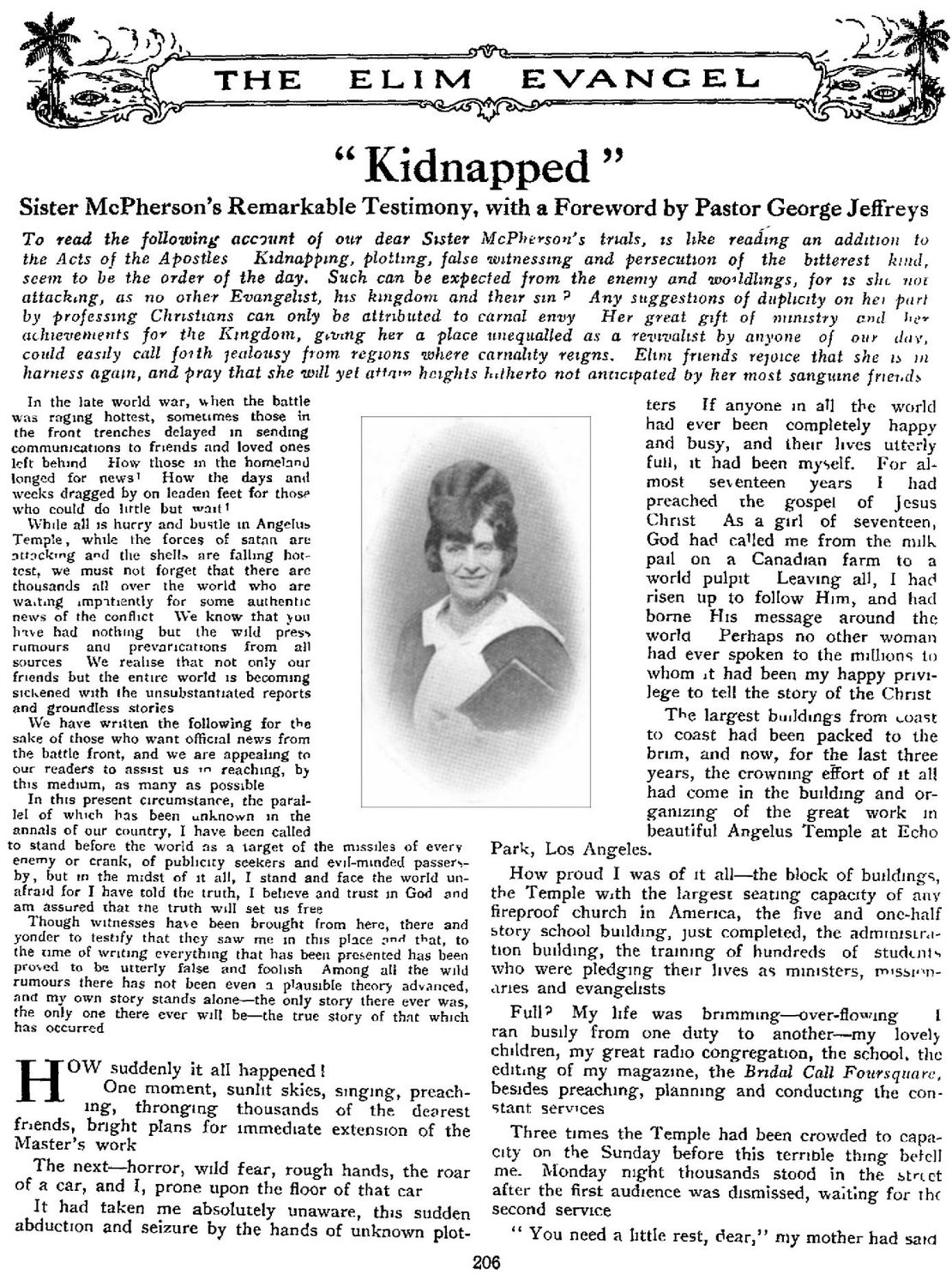
The Elim Evangel, Vol. VII, No. 18 (15 September 1926), pp. 206–211, 213–216.
[FOREWORD] To read the following account of our dear Sister McPherson's trials, is like reading an addition to the Acts of the Apostles. Kidnapping, plotting, false witnessing and persecution of the bitterest kind, seem to be the order of the day. Such can be expected from the enemy and worldlings, for is she not attacking, as no other Evangelist, his kingdom and their sin? Any suggestions of duplicity on her part by professing Christians can only be attributed to carnal envy.
Her great gift of ministry and her achievements for the Kingdom, giving her a place unequaled as a revivalist by anyone of our day, could easily call forth jealousy from regions where carnality reigns. Elim friends rejoice that she is in harness again, and pray that she will yet attain heights hitherto not anticipated by her most sanguine friends.
HOW suddenly it all happened! One moment, sunlit skies, singing, preaching, thronging thousands of the dearest friends, bright plans for immediate extension of the Master's work. The next—horror, wild fear, rough hands, the roar of a car, and I, prone upon the floor of that car. It had taken me absolutely unaware, this sudden abduction and seizure by the hands of unknown plotters. If anyone in all the world had ever been completely happy and busy, and their lives utterly full, it had been myself. For almost seventeen years I had preached the gospel of Jesus Christ. As a girl of seventeen, God had called me from the milk pail on a Canadian farm to a world pulpit. Leaving all, I had risen up to follow Him, and had borne His message around the world. Perhaps no other woman had ever spoken to the millions to whom it had been my happy privilege to tell the story of the Christ.
The largest buildings from coast to coast had been packed to the brim, and now, for the last three years, the crowning effort of it all had come in the building and organizing of the great work in beautiful Angelus Temple at Echo Park, Los Angeles.
How proud I was of it all—the block of buildings, the Temple with the largest seating capacity of any fireproof church in America, the five and one-half story school building, just completed, the administration building, the training of hundreds of students who were pledging their lives as ministers, missionaries and evangelists.
Full? My life was brimming—overflowing. I ran busily from one duty to another—my lovely children, my great radio congregation, the school, the editing of my magazine, the Bridal Call Foursquare, besides preaching, planning and conducting the constant services.
Three times the Temple had been crowded to capacity on the Sunday before this terrible thing befell me. Monday night, thousands stood in the street after the first audience was dismissed, waiting for the second service.
"You need a little rest, dear," my mother had said. "Why not slip away to the beach for a few hours?"
How I loved them—those rolling billows of the great Pacific! What rest, exhilaration and refreshment they always brought me.
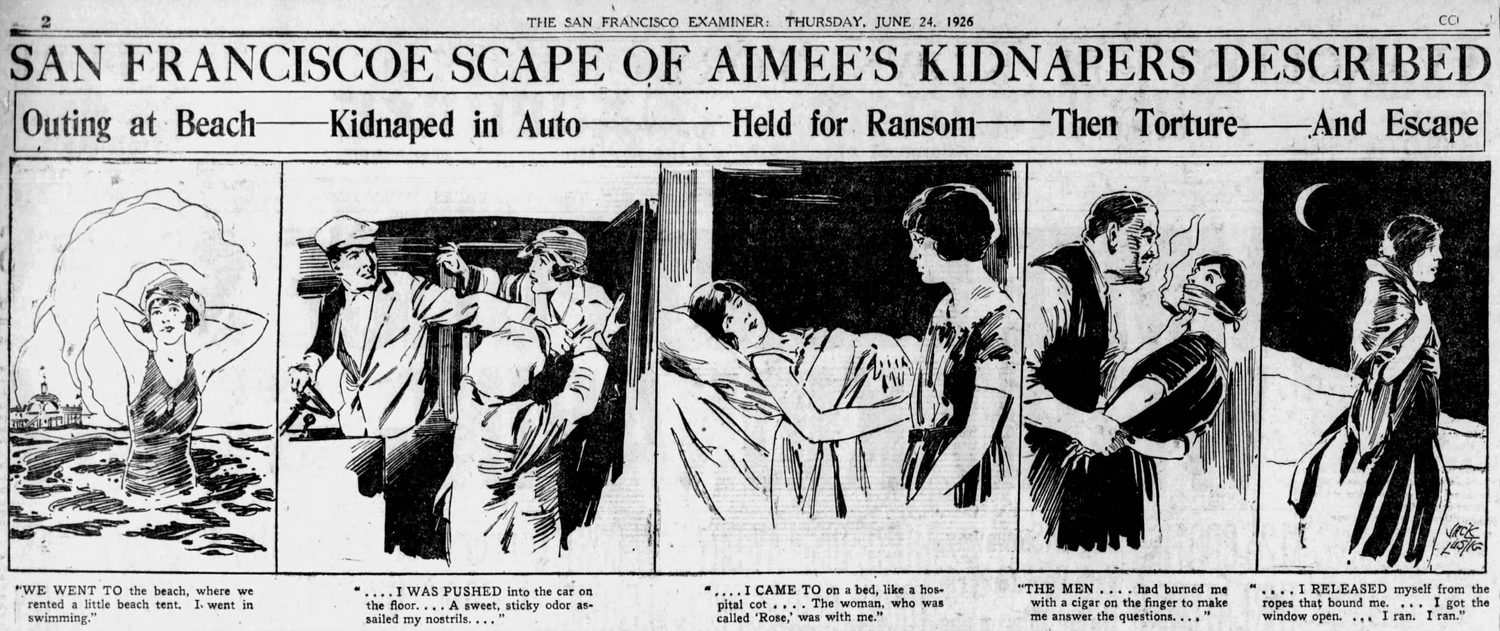
Happily we sped along the highway, my secretary, Miss Emma Schaffer and I, laughing, talking, planning, thinking of future messages and sermons. There it lay—the broad bosom of the sea, with the waves piling in upon the silver sands. It took but a moment to slip into a swimming costume. Then the plunge into the surf. Then stretch luxuriously upon the sand beneath the little beach tent to enjoy it all and drink in the fresh salt breezes from the mighty deep.
Even pleasure could not occupy my whole mind for long. There were those Sunday sermons! I began to work on them, having brought my Bible, pencils and note-book with me. "Darkness and Light," had been chosen for my sermon subject. It seems curious now, remembering what happened, that that phrase should have come into my mind when I began to plan for the Sunday services.
"Out of darkness into light." And I, suspecting nothing, was about to plunge into a darkness more terrible than anything I had ever imagined. The darkness of suffering, of fear, of well-nigh despair. Then, into the light! I was to come back; into the blessed light of safety, of love and home.
It was even to be, that when I stumbled feebly, desperately along that road, a light should be my first token of hope.
NEVER will a light look more glorious to me than the crimson glow of the flames that I saw against the sky, when, exhausted by the long miles across the desert, I saw far away in the night the red glow that they told me afterwards were the Douglas smelter fires.
I did not know what they were. But surely they meant human habitation—people, telephones, rest, shelter and safety. And that little light burning over the door of the house in Agua Prieta, the one light in that dark street, silent except for the clamour of the dogs.
"Come," it said to me. "Here are friends. Here is shelter. Here you will be safe. In the light!"
But, as I sat there on the beach in the sea wind and the sunshine that May afternoon, turning the leaves of my Bible and writing notes for my sermon, I did not know. There were so many things to think of—happy things.
There was the meeting of that very night. I had forgotten to request some special music and some illustrations which should have been ordered. Accordingly, I asked my secretary to telephone the city, as she had not gone in the water; and I plunged in for another swim.
STRAIGHT out I swam, ploughing through the billows, then toward the pier and back, hand over hand, laughing up at the seagulls that circled and dipped overhead. Oh, how I loved to swim!
Suddenly I heard my name called.
Turning, I saw a man and a woman standing at the edge of the water. Even in my brief hour of recreation, the call of duty was never silent for long. Making my way to the shore, I looked into the faces of the couple solicitously, for both seemed under great nervous stress. The woman was visibly trembling and looked on the verge of tears.
"Oh, thy baby!" she said. "My baby! She is dying. The doctor has given her up. Oh, Sister, come and pray for her! Won't you? You will come!"
"We have her right here in the car." This eagerly from the man, who stood twisting his hat in his hands.
"How did you know I was at the beach?" I inquired.
"We drove in all the way from Altadena with the baby. We went to the church and told your mother the story. She said you had gone to the seashore, but if we could find you, she was sure you would take a moment, under the circumstances, to pray for the little one. Oh, please hurry!"
"But I can't go now. You will have to wait until I get dressed."
"No! No! Have a coat here."
Suiting the action to the words, a large loose coat like a mackintosh was thrown over my shoulders. I slipped my arms into the loose sleeves, noticing with approval that it came well down toward my feet.
"Right this way. It will only take you a moment. Even if the baby should die, we will feel better to know that you prayed for her."
A diagonal walk across the sand to the broad walk, between the couple. "I will go on ahead. I am so anxious," said the woman, speeding with apparent mother love up the street. Poor gullible me! I had not stopped to think that they had never been to mother. I had told several people out on the sidewalk where I was going and anyone could have easily followed me, before leaving the Temple, but that never entered my mind.
Walking by the side of the man, I soon reached a sedan. We approached the car from the rear. The door was open. A man sat behind the wheel. The woman sat in the far side of the back seat, holding a bundle of blankets or shawls, which I presumed to be the baby, in her arms, gently rocking and crooning to it.
"You had better step in," said the man. "You can reach the baby better."
Only too glad to do this, being barefooted, I stepped on the running board, my weight thrown forward.
Then upon me, utterly unsuspecting, trusting in them, fell this terrible thing. Dear Lord, I have lived it through a thousand times since then. Shall I ever forget it?—the quick, strong shove, just beneath my shoulders, that threw me forward on my face and arms so that I fell to the floor of the car. A smothering, suffocating mass of blankets over me—a hand holding something that felt like a sponge on my face—a sticky, sweet odour, a gasp, a struggle, a firm hand at the back of my head, the roar of a motor and it grew dark.
WHEN next my eyes opened, I was lying in a white iron bed, desperately nauseated. A woman was bending over me—the same woman who had pleaded the cause of a dying baby.
Dazedly, then with increasing alarm, I looked about me. My first thought was that there had been an automobile accident and I had awakened in a hospital. The room was strange. The blue and pink wallpaper was unfamiliar. The bed, the dresser, the cot, the chair, the boarded window—none of these I knew.
"What—where—why, you are the lady with the baby!" I finally said. "Where am I? What has happened?"
Without answering my question definitely, the woman, who later, when I asked her name, told me I might call her "Rose," called two men from the adjoining room. One was the man who had accompanied her to the beach, and the other, the man who had sat behind the wheel of the car.
There they stood at the foot of my bed. One man rather heavy set, brown hair and fair complexion; the other tall, dark and slim. They answered my questions, but the answers seemed to freeze the blood in my veins.
"What were they saying? Held for ransom! Why? Nonsense! Surely I was dreaming. One read of such things in the papers. They happened to others, but never could they happen to me. Was I dreaming? A nightmare?"
"But it is ridiculous!" I protested. "I must go back. I have to address a great audience. My mother will be frantic! My children—the training school—it is examination time! My papers are all to be corrected. There is the radio—the people, the—Why, you must take me back!"
"Oh, you will go back, all right," they said, "when we get what we want."
DULLY I lay there and watched until the two men left the room. The woman, who was my constant attendant, who slept in the room with me, and who took what I suppose one would call good care of me, under the circumstances, had left the room also for a moment.
Arising from the bed, I made my way to the window and gave shout after shout. It was but a moment until the three were in the room again and ordered me to stop that. Later I tried it again, but the man they called "Steve" and the woman held me and put a wad of white cloth in my mouth and tied it firmly behind my head. They removed it shortly afterward, and told me that if I called out again I would be gagged and stay that way.
Looking at the words after they are written, I shake my head and feel that it is all a mistake—that it could not, just could not have happened. It all seems too melodramatic, too far-fetched, too unreasonable and strange, but it did happen, and if all people in the world, it happened to me, whose well-ordered life was filled with incessant duties of ministering to the sinful, the sick, the dying and the needy.
Day after day, night after night, this one room was my habitation. I lost all track of day and date. Hour after hour, day after day, I lay on the bed or paced that little room. My thoughts ran in an endless circle, the picture of my prison and my jailers was burned on my mind. I can close my eyes and see it all.
Where had I been taken in that car, while I lay unconscious under the smothering blankets? In what lonely, hidden place was I a prisoner? There was running water in the house, but how much did that mean? That water might be piped from a well or we might possibly be on the edge of some town. There was neither comfort nor cheer in my prison room. Only the merest necessities. The furniture looked as if it had been used for a long time. There was a white iron bed, on which I had awakened from oblivion to realize the terror that had come to me. There was a cot, where "Rose" slept. There was an old dresser, varnished brown, and badly worn, with a mirror. I used to look in that mirror and wonder if it were my face that looked back at me.
I SAW my face growing thinner and the lines deepening. I saw that the face in the mirror never smiled. I saw that the eyes that looked back at me were dark with weariness and despair.
I tried to cheer and comfort the woman in the mirror.
"You will get away somehow," I told her. "You must get away. I don't know how. I don't know when. But don't give up. You have trusted in God all your life, trusted Him in joy and sorrow. He will not fail you now. Be patient. Be brave."
Oh, how I longed for my Bible that had always been my companion and comfort. If I could have brought that, I thought, I could have sought shelter in its blessed words from the despair that was closing in on me. Over and over, I repeated to myself verses I knew.
"Yea, though I walk through the valley of the shadow of death, Thou wilt be with me. Thy rod and Thy staff shall comfort me."
That was my only refuge—my belief and my trust in those promises.
Hour after hour I sat thinking—thinking.
Where was I? What had happened? Who were these people? What had I, who loved all the world, ever done to them? Why, oh why, should this have come to me?
Many times my thoughts fled out over the unknown miles—home.
What was happening there?
My mother—what was she doing? What was her sorrow? What could she think had become of me?
My children—what had they been told?
My friends, my people—what were they saying, thinking?
And I was alive! I was here—somewhere! Alive and helpless.
There were no electric lights. When night came, Rose brought a kerosene lamp into the room. Even that little thing strengthened the terrible sense of isolation. An electric light would have meant civilization, a wire leading somewhere, away from my prison to a place where I might find safety, a guide to lead me if I could escape. I was alone, lost, helpless, cut off from everything I had known.
NOW and then, during those days that are not yet clear in my mind, the men came into my room to talk to me, to tell me of their demands for ransom which they expected to receive from my mother and the church as soon, said they with an oath, as they could "kill the drowning theory."
Just as the room, the wallpaper with its blue stripes and pink flowers, are burned in my memory, so are the faces and the voices of my captors.
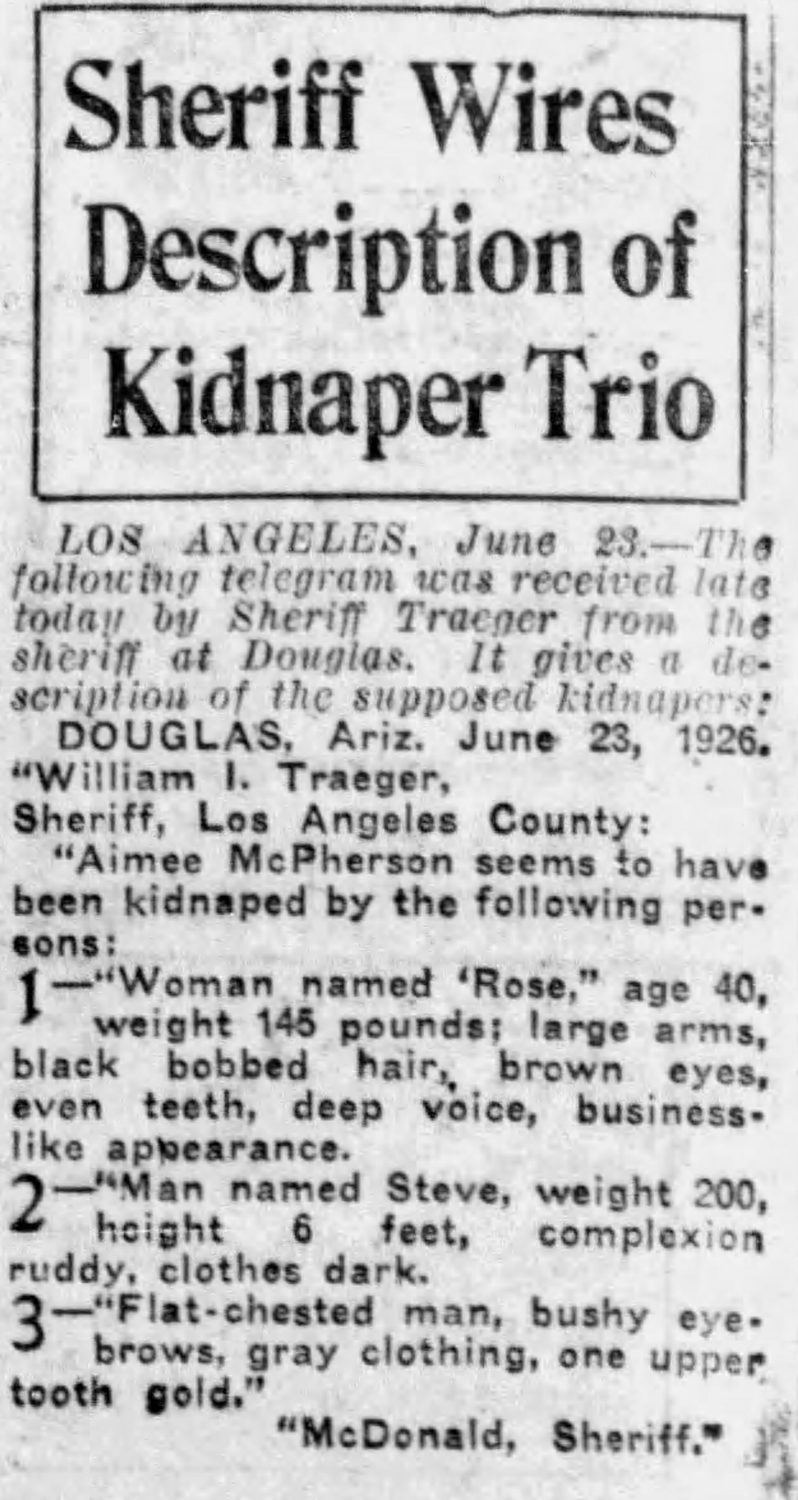
"Rose" was a woman perhaps in her late thirties. She was, I think, about five feet seven inches tall, and weighed probably one hundred and eighty-five pounds—not stout, but ample and solidly built. She had black, bobbed, fluffy hair, an olive complexion, dark brown eyes and rather full lips. Her manner was like that of a practical nurse—competent, matter-of-fact, and in her way, I suppose, kindly. She did not speak like an illiterate or ignorant person, and her dress was very plain.
She called me "dearie" in a gushing sort of way, the "dearie" that has no tinge of affection but is simply a manner of speech.
"Steve" was a tall man, perhaps six feet, although I think I was always lying on the bed when he came in with Rose to talk to me, and it is hard to judge height that way. He had a fair complexion, medium brown hair and he was heavy set. I am not sure as to the colour of his eyes, but my impression is that they were light. There was nothing particularly distinctive about him, but I would know him again in an instant.
I never heard the name of the other man. He took only a small part in the conversation, and neither "Rose" nor "Steve" called him by name. He was also tall, rather slight and dark.
Though "Rose" was with me all the time, I saw comparatively little of the two men. I think "Steve" must have been away a great deal—perhaps as their link with the outside world. The dark man would sit in the other room most of the time. I believe I would know all three of them again if they were brought before me.
CAME a time when the woman began to ask me about my Canadian home. We talked together during my days of captivity, talked about little unimportant things, for wherever I asked questions, she always answered "Dearie, we won't talk about that now."
One day she asked me casually if we ever had a hammock and what kind of one it was. She led up to it, I realize now, by saying the weather was warm and a hammock would be comfortable.
I told her we did have one, made of woven wire, fastened between two apple trees.
She asked me if I were fond of dogs, and I told her I was very fond of them. She asked whether we had kept one in Canada, what colour it was, and its name. I told her it was a black water spaniel, and its name was Gyp.
By that time the men had entered the room, and something in the way they winked at one another and the look of elation in their faces made me suspicious. One of the men asked something about our dining-room stove in the country, and whether we had a relative by the name of Wallace.
"Why do you want to know?" I asked. "Why are you asking me all these questions?"
Then they told me that my mother believed me to be drowned while swimming at the beach, and before they could get her to pay them ransom money, they must make her believe I was alive and well. They said mother had asked these questions.
When they said they were holding me for five hundred thousand dollars, I refused to answer the questions, saying that I would rather die than cripple the church to such an extent.
"Oh, your folks have plenty," they scoffed.
"But not five hundred thousand dollars! No church could pay that amount."
"Why, you have multitudes there," they said, "and if five hundred people gave a thousand dollars apiece, it would be raised."
"I won't answer your questions—not one of them!" I exclaimed.
"You will if you know what is for your own good. You will answer them and answer them quick," said a gruff voice, and a strong hand fell upon my wrist. A lighted cigar butt was placed to first one finger and then another. There are still, at the moment of writing, scars on my fingers, though some weeks have elapsed.
Instead of showing fear, somehow I had the presence of mind to keep perfectly steady, though I winced a little. Looking up into their faces, I said, "Go ahead."
A little shamefacedly he desisted.
Practically all the time of my absence from home was spent in this one house. The man called "Steve" was absent a great deal of the time—presumably on trips concerning the working out of the ransom plot. Hour in and hour out, I paced the floor to and fro.
Dressed? Yes. The woman had given me clean clothing, too large for me—they may have been her own. Also she had given me shoes and stockings.
ONE night, after the man whom they called "Steve" had been absent for some days, he returned and the trio sat talking until late in the night. I caught snatches of their conversation, and deduced that they were angry, and that some plan to obtain money had failed. Scraps of conversation drifted to me after I had retired. One of them was, "Don't they think we know a d—— dick when we see him, even if he is beribboned?"
They swore a great deal.
They did not hurt me again, after that one attempt with the lighted cigar. Nor did the men ever make any attempt to harm me. That danger was only suggested when they said that if my mother did not do what they wanted, they would sell me to Felipe of Mexico City.
One night, sometime after hearing the conversation about the "dick," I was asleep when "Rose" awakened me and told me to get up and dress. Evidently they had suddenly decided to move. I was blindfolded and taken out and put in the car. The right half of the front seat of the car had been folded forward. A narrow mattress, evidently the one from "Rose's" cot, had been laid upon the floor, and I was placed upon it, my hands and feet tied firmly but quite comfortably.
Then began a long trip. During the journey, I recall but one or two stops and these seemed to be in the country. One was to put in gasoline, which I believe was carried in an extra can. Only once during the trip was I gagged. I remember that at the time there was a rumble as of some traffic, though we might be passing through a town.
I was helpless, lying there with my hands and feet tied, in the bottom of the car. Oh if they would only let me stop somewhere near human habitation, even if they gagged me, surely I could make some sort of disturbance that would attract attention. My feet were tied but I could kick the side of the car. But they did not stop where such a thing was possible.
Once or twice the car slowed down, and I thought—"Now perhaps I can do it." But there was a sound of voices outside the car. It might have been in the country.
"Rose" and the dark man, whose name I never heard, were in the car. The man drove. "Rose" sat in the back seat. "Steve," I think, must have gone in the other car with the camp equipment, for there was nothing like that in the car that carried me.
How long that day was! We drove on and on. Sometimes the roads were smooth, sometimes rough. I could not see out. My head was far below the level of the car windows.
The day passed and darkness had once more fallen. I was taken from the car, blindfolded and hurried into a room in some house or shack.
BY this time my nerves, which had held up for so long and of which I had always been justly proud, had given way, for among other things they had told me my mother had collapsed. I pictured her in all sorts of horrible conditions, possibly drawn stiff with a paralytic stroke, or dying, and my children left alone. My case seemed hopeless, and for the first time, I began to feel despair and to feel that these people were not only plotting for money, but perhaps the devil, who is ever an enemy to the cause of Christ, to revivalism such as I had been preaching with might, in the confusion of the powers of darkness, had conspired against me that I should never more stand in my pulpit or issue the call for men and women to come to Calvary's fountain.
All strength seemed to leave me. I could not stand, but felt to the floor. I took no interest in my surroundings or my food. We had lived practically all this time on canned goods. A prolonged hysteria had fastened itself upon me. I was dimly aware that the men had gone and "Rose" was alone with me.
"Oh, it is so hot!" I complained at different times.
"Never mind dearie," she answered, "if your mother behaves herself and does what is right, you may be home next Friday night."
The men had gone, then, had they, to put on the final clamps? What would mother do? How would she raise the money? What would the people say or think? What would become of the church?
Round and round my thoughts circled until my brain swam and my head seemed bursting.
I cannot describe this second prison of mine very well. It was dark when we arrived, and before they took me out of the car and into the shack, they tied a handkerchief over my eyes. That is about all I knew, save that the room where they kept me was small and the walls were dark. There was a window, but all it showed me was a lonely stretch of desert.
"Rose," "Steve" and the other man brought in the camp equipment that they must have carried. As I remember, the cots were already in the room when I was taken in—brown khaki army cots and blankets. There was a camp chair. A pail and a dipper stood in one corner, and there was a big tin can that was my salvation when, in those frantic minutes before I escaped, I sought for something to cut the bind that held me helpless. It was terribly hot—the desert heat. I was exhausted and the heat oppressed me frightfully.
"Oh, I can't stand it—it's so hot!" I moaned to "Rose" when it seemed now and then, as if I could not endure it another moment.
"Now dearie, don't worry," she would say. "It won't be long. It isn't as hot here as it is in Honduras."
Were they planning to smuggle me away somewhere else, I wondered. Honduras? Why should she speak of Honduras?
I was growing very weak from the heat and the endless worry. Most of the time I lay on the bed. It seemed to me that surely the end had come.
The men were there at first. They seemed anxious about something. They and "Rose" talked together a good deal.
A day or so after we reached that place—I cannot remember days exactly—the men went away. I heard the car start. I was left alone with "Rose."
It was the first time both men had gone away and left me alone with her.
Then, it must have been Tuesday, the day I escaped—all days were alike to me by that time—"Rose" came in with a tin basin of water and washed my face.
I was very weak. All I could think of was my mother.
"Mother—poor mother!" I remember moaning over and over again like a child. I was thinking how she must be suffering. All those days with no word from me, all those days of anxiety and waiting.
I tried to get up and walk around the room a little, but I was too weak. My limbs would not hold me. Everything was whirling around me. I crept back to the bed.
"Rose" came to me. In her hand she held some strips of cotton cloth, flat strips, something like those you turn a mattress with.
"Now dearie," she said, (Oh, how I shrank from the insincerity of that incessant "dearie") "Dearie! I must go for provisions. I'll have to tie you for a little while. I'll soon be back."
"But I am so weak," I protested, "I don't believe I could stand or walk long."
"Yes, I know," she said, "but I'll have to tie you just the same. We can't take any chances. I won't hurt you. Please tie my hands in front of me, then," I begged. "My arms and shoulders get so stiff when my hands are behind me."
"Rose" shook her head.
"Lie down on your side," she said. There was nothing for me to do but obey.
She tied my hands behind me. My feet were crossed and tied that way. The cloth was not tied tightly enough to hurt, yet enough to hold me.
"Rose" went out, and I heard a car start. The engine sounded like that of a small car with a light motor. There were no voices outside and I was quite sure that the men had not returned.
IT was the first time that I had been left alone. Possibly I was so weak now, not having felt able to stand for more than a few moments the last days, that she felt it safe to go for supplies.
At any rate, now was my great opportunity for escape, if only I was strong enough.
Could I make it? Desperation and hope lent strength to my weakened frame. I prayed with all my soul for power to thrust back the weakness that was upon me, for the mist to clear from my tired mind.
"Oh, give me strength—Lord give me strength!" I prayed.
My ankles had been crossed in the tying. It was impossible for me to walk, even with short steps. I rolled from the cot and across the floor. There, by the wall, stood a square tin can, like an oil can. The top had been cut away in such a manner as to leave a sharp edge.
Lifting myself with difficulty to a sitting posture, I managed to turn my back to the can and press the bands that bound my wrists against the sharp edge. Awkwardly, but persistently, I sawed the bonds against its edge, until at last one strand parted. My wrists became chafed and bruised, but it was done, and in a moment my hands were free.
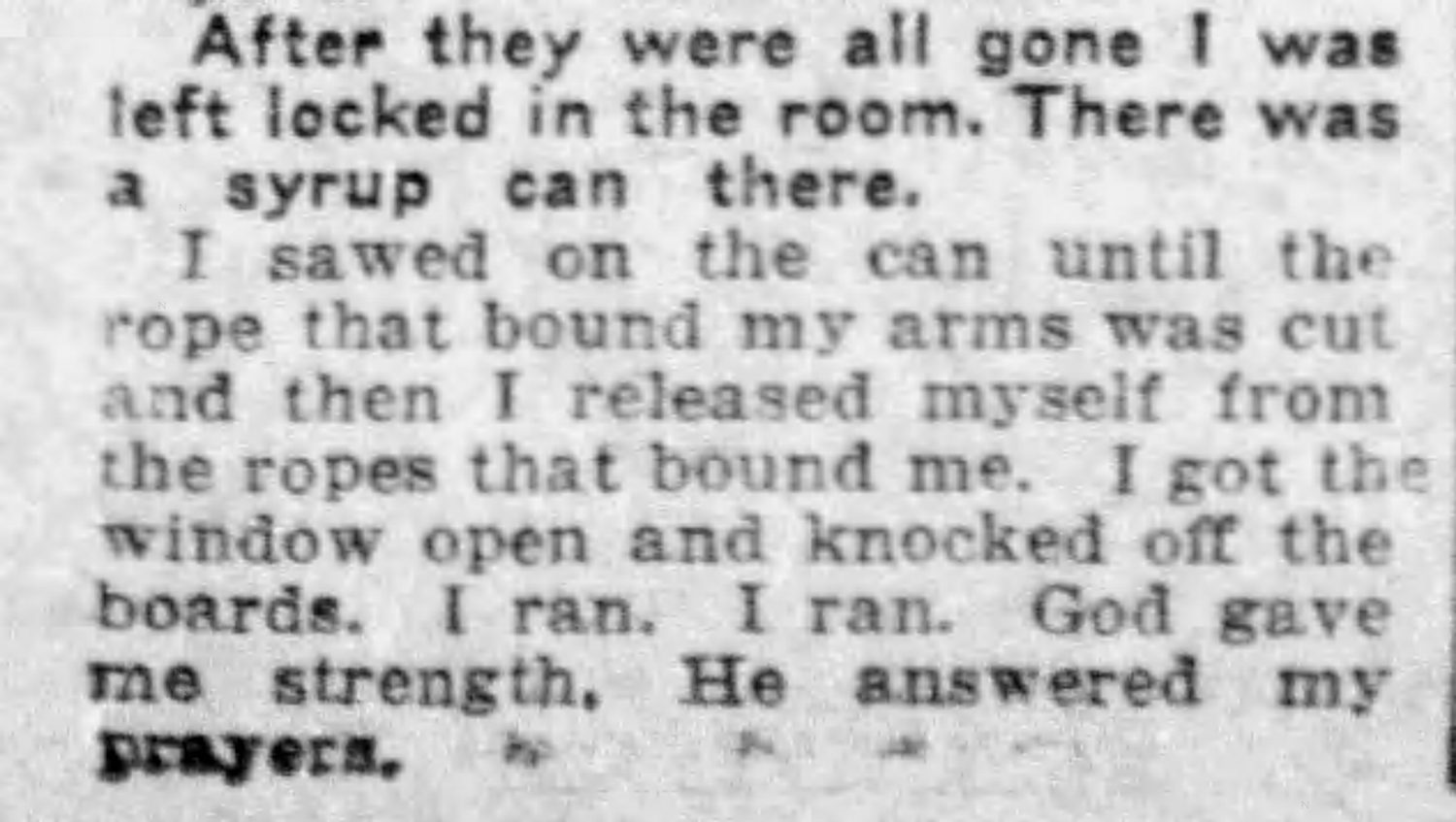
Loosing my feet and chafing my ankles, I stood up. I could walk. I reached the window and climbed out, and like the man in the Bible days, "I stood not on the order of my going." I ran straight ahead—ran and ran—and was only stopped by a sharp pain in my side.
Fear and haste that had clouded my vision cleared a little, and I took stock of my surroundings. I was in a desert. Rolling country, covered with growths with which I was not familiar, stretched far out for what seemed to be endless miles. By the sun, I would judge that it was about eleven o'clock in the morning.
Was I on the California desert, or in the region of Imperial Valley? But there was no time for speculation. Hurry! Hurry! At any moment the car might return and my absence be noticed.
Which way was I headed? That did not matter either. The main thing was to get away, anywhere. On, on I sped. The sun was blazing down hotly, but having on a long white cotton underslip, I was able to turn my dress over my head and arms as protection from the burning rays.
Down through little gulleys, up over little knolls, on across level stretches of country, weaving in and out among the desert growth, stumbling sometimes, yet going on and on, ever on until the sun was growing low. No human soul did I see.
I SHOULD judge it would be about five thirty o'clock in the afternoon when, exhausted and thirsty, I determined to head for a certain dark hill which stood out above the rest and which I later learned to be Niggerhead Mountain. Possibly here there would be water or shelter.
When I reached the hill the moon was shining brightly and all the stars were looking down upon the desert. It was a beautiful sight, but I, who loved the heavens, was in no mood for enjoying their glory on this night. Stark terror had taken hold of me.
I remembered many stories of people who had died in the desert, hopelessly lost, perishing for food and water.
To my unspeakable joy, from an elevation at the foot of the mountain, I saw in the distance a glow of light in the sky. What was it? Looking closely, I saw a cluster of lights, too low, too bright for the stars.
It was—it was a city of habitation! How far it looked—yet it was there! Thank God! I was not lost!
Could I make it? Yes, and I would!
Winding my way down, I found a road which showed signs of travel. New courage and inspiration came to me. I pressed on. My feet, however, were very sore and tired. My knees and limbs trembled beneath me. I felt that I must needs spend the night in the desert and press on in the morning, but oh, I was so thirsty and my lips and tongue so dry.
How far had I come—ten miles or fifteen? It seemed to my weary, faltering limbs that it must have been twenty. I had no way of determining the exact distance.
Many times I lay down, scooping up the sand for a pillow and laying my head upon the skirt of my dress—not a shade from the sun now, but a wrap to protect me from the chill of the night.
As I lay there looking up at the stars, I hoped that a traveller might pass that way and see me and pick me up, but I could not rest.
I had gone along the road for several miles—I cannot tell how far—when in the moonlight I saw, on my left, a little building. It was the first sign I had seen of human habitation! I was terribly tired, but I almost ran toward the little building.
"Help!" I called. "Who's there?"
There was not a sound.
I reached the door of the shack. It was open. The hut was deserted.
I walked back and forth, peering in at the door, hunting vainly for signs of life. It seemed too cruel that there could be no one there, but it was true.
I went back to the road and started again. How much farther?
"You are on a road," I told myself, trying to keep up strength and courage. But I was tired, so tired. I had walked for hours under that blazing sun, walked and ran, afraid to look back, listening always for some sound behind me, some shout that would tell me "Rose" and the men had come back, discovered my flight, and were following me.
The night was terrifying but it was also a blessing. The night wind was cool. The heat of the sun was gone.
And then, I thought: "Suppose that they do find out that I have escaped. Suppose they follow me. They cannot find me in the darkness."
I was so tired that I could not walk far at a time, and now I felt that I could not take another step. But then I remembered something else, something that I had forgotten before, when my only thought was to get away from my prison.
Rattlesnakes! Gila monsters! Lizards!
They lived in the desert.
SUDDENLY it seemed to me that the night was filled with strange noises. I heard dry rustles in the sagebrush—here—there—all around me.
I tried to force myself to keep still, to rest. I knew the night wind was moving the sagebrush, that there were harmless little desert creatures which could not hurt me. But my imagination was running riot. I could not endure it. I got up and hurried on.
Again I hoped that a traveller would come along and find me—but I remembered that it was night, and I could not hope for that help until day came, and I could not wait for day.
Many times I lay down but always I crawled to my feet and started on once more—on toward these blessed lights.
After more weary miles, I saw lights away off at my right. I shouted, but my voice sounded so little and thin in the vastness of the desert.
"Yo-o-o-o hoo-o-o-o!" I called. "Help! Please help me!"
But no voice answered. There was nothing but the barking of dogs in the distance. It seemed to me at all times that I was walking in my sleep with my eyes closed. My eyelids were so heavy they refused to stay open.
"Yo-o-o-o hoo-o-o-o!" I called again.
Dogs were barking! To my right a dark blotch outlined itself against the sky. Was it? Yes, it was a building, and a large one, too. I pressed on toward it.
Finally, a man's voice was heard silencing the barking dogs.
By this time I had reached the high wire fence which later proved to be the line between Mexico and Arizona. As I stood and clung to the fence, trembling with mingled joy and exhaustion, a light was struck in the house which stood at the rear of the large building, and a man came to the other side of the fence. He peered through, and demanded:
"What do you want?"
"I want the police," I answered.
"The police? What have you done?"
"Nothing, but I want the police. Have you a telephone?" "What do you want the police for?"
On, on, question after question, until it seemed I would drop where I stood. I saw that I could not make him understand my plight.
"Have you an automobile?" I asked. "No."
"A horse?" "No."
"Will you get dressed and come with me to the village?" "No. Have to work all day."
Then his voice changed to a more kindly tone. "Won't you come in and rest until morning?"
"What is this place?" I asked.
"A slaughter house," he replied.
"Have you a wife? Are there any women in the house?"
"No, but you better come through the fence anyway. Then you will be on the American side. You are in Mexico now."
I took another look at the man and decided to stay on my side of the fence, for he had told me it was only a mile to the nearest house.
Only—a—mile, but oh, what a mile!
For years I have usually gone wherever my track necessitated, in my car. Never have I walked at one time so many miles as I did that day and night, starting out at approximately noon or just before, and arriving at the first house of habitation between one and two in the morning—totalling nearly fifteen hours. What a day! What an experience!
HERE at last was a village! The small houses lined either side of the street. Passing the smaller ones, each of which possessed one or more dogs, which barked in all keys and tones, I pressed on, the only human figure on the street so far as I could see.
Dogs of all sizes chimed in the general uproar. There was the tiny yip of the wee ones and the deep-throated ominous growl of the larger. On I went until I came to a large house with a fence and a bushy hedge inside. It looked promising—like the home of responsible people. There was wire running from the street to the house. Could it be a telephone? And, too, there was a light on the door.
I rattled the gate. Dogs barked here, also. Surely every Mexican must own half a dozen dogs. Surely here would be hospitality, friends and succour.
"Will you help me?" I called. My voice sounded strange, even to myself. "Will you please help me?"
"Who is it? Come in," said a man's voice in rather broken English.
I took a look at the tiny dog—the bark of the large one sounded from inside the house—and I made my way up the walk to the piazza.
"What do you want?"
"I want the police. Please help me. Have you a telephone? I want a telephone quickly."
"No, but there is a telephone just up the street. One block, across on the other side."
"Oh, I wish you could help me."
Turning from the piazza, I went down the steps and started down the walk, saying to myself dully: "One block—just—one—more—block—now. Just one—more—"
I wavered to and fro on the walk, reached the gate, partly opened it, then crumbled. The last I remember was that when I fell my head was lower than my body, and I was half in and half out of the gate. I do not know how long I lay there unconscious.
The people had come out of the house, and they said afterwards that they thought me dead. When they saw life was still in me, they laid me on the piazza and covered me with blankets.
What kindly folk they were! I think the first word I spoke was "Water! Water!" Though the women had not been able to understand much English, they understood that word and pressed a glass to my lips.
How good it was! My tongue was swollen and my lips were parched. I called for a second glass. Water and the police were the two things I wanted most in all the world just then.
I remember that when I awakened there by the gate, the man had lifted my head in his hands and was holding it very gently while the woman stroked my hands.
"Señorita—señora," I heard him say through that mist of half-unconsciousness. "What is the matter? What is the matter?"
How good it was to look into a kindly woman's face again. I thought of "Rose"—of her hard, cruel look that even her gushing "dearie" could not hide.
How different was this woman's face, bent so anxiously over mine! How beautiful she looked to me.
They tell me it was two hours before I could speak enough to whisper the word "police," so that the man could understand. They thought I was dying when I fell there at the gate.
The next faces I saw were Mexican, too, but kindly and anxious.
"Where am I?" I whispered.
"Agua Prieta," answered one of the men.
"Agua Prieta. Where was that? In Mexico, surely, but where?"
"Douglas—American city—over there," said one of the men.
"An American city! Then I was safe—safe at last!"
"The police—I want the police," I whispered.
"Señora, I am of the police," was the reply. I seized his hand and held it fast. Mexican, American, what did I care? Here were the police, law, authority, the power to protect me.
No officer ever looked so good to me in all the days of my life. Sometimes I feel I will stop at every corner where there stands a traffic officer and shake hands with him, from now on until the day of my death.
When I had revived a little—and there is nothing like relief and joy to drive away the mists of unconsciousness—these kindly folks sent for an American taxicab driver. He took me across the border, brought me to an American hospital and called an American policeman.
This policeman told the hospital authorities that he would guarantee my bill, whoever I was. I was an American woman in need of care. That was enough for him.
At the hospital I had difficulty in persuading even one person to believe that I was Aimee Semple McPherson.
"Are you sure you are Mrs. McPherson?" they would ask.
"Absolutely."
"Have you any proof of it?"
"No."
"Do you mean that you are Aimee Semple McPherson?" "Certainly."
A man came in and looked at me closely. Then he paced back and forth across the floor, hands behind his back, and stopped at the bed and looked at me closely again. Time after time he repeated this, shaking his head.
"Would you mind—" he finally said.
"No! What?" I replied.
"Would you mind—"
"No! I wouldn't. What is it?"
"Would you mind blowing your breath in my face—just once?"
"Why no," I replied, not realizing what he might mean by such a request. I did not understand that since I had been found across the border they thought that I had been drinking and was imagining I was Mrs. McPherson.
I did what he asked, and forever settled that idea.
At last they believed me. They told me they would telephone to Los Angeles, to the police and to my mother.
I lay there waiting, while the nurses, the dear kindly nurses, made me comfortable. Would they ever get the call through, I wondered?
And then at last, the men came back to my room. They had Los Angeles on the line, they said. What should they say that would prove to those far away people who I was?
I told them little things about my girlhood that I knew no one but my mother would remember.
I told them to say: "The scar on her finger is from a cut she received when she was a little girl. The man who cut her in that accident was named Pinkston."
I told them about my pet pigeon, Jennie, and the cat named Whitetail.
But there had been so many rumours, so many sensational reports that I knew nothing about. So many times the word had come: "She is here—she is there—"
At last the men came back again. "Can you manage to come to the telephone yourself?" they asked. "If your mother hears your voice, she says she will know."
Could I? To speak to my mother? If that telephone had been a mile away, even a mile of desert road, I would have gone to it.
I could scarcely hold the receiver, scarcely control my voice.
"Hello, darling."
And back over those miles of wires came the voice I had thought I would never hear again.
"Aimee! Oh, thank God! Thank God! Aimee!"
And in that Douglas hospital, clinging to the telephone, with the nurses smiling around me, I breathed the same prayer of joy.
"Thank God! Oh, thank God!"
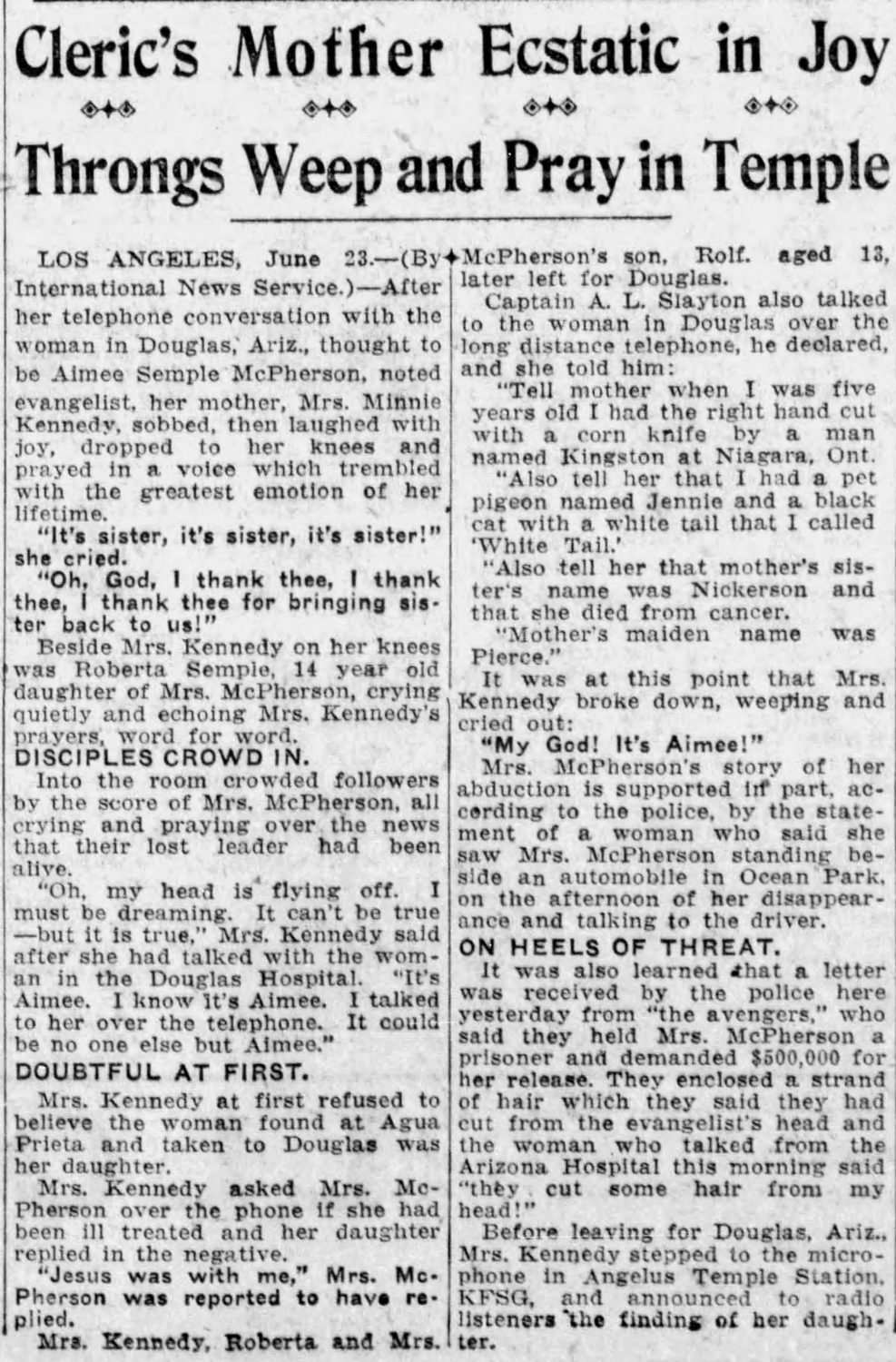
IT seemed that the hours would never pass—that the morning and Mother would never come. When at last my mother and my two children arrived the terrible experience was all in the past and a new day had dawned.
WHAT scenes of excitement were enacted in Los Angeles and in Angelus Temple, I can scarcely tell. From all reports since received it is evident that it knew no bounds. Like balloons, with the ballast suddenly cut loose, hearts leaped out to the heights of joy, and yet in spite of weariness, weakness and a haunting memory of a terrible experience, I think there was no heart more happy and joyously singing than mine when at last our train drew into the depot.
What crowds! What shining faces! What singing of the praises of the Great Deliverer!
And the Temple! It was simply a bower of bloom! Friends and well wishers had fairly outdone themselves to make it a happy home coming and to express, by their floral offerings, the joy of their hearts that God, by His mighty stretched forth hand, had delivered one of His little children from the clutches of the enemy.
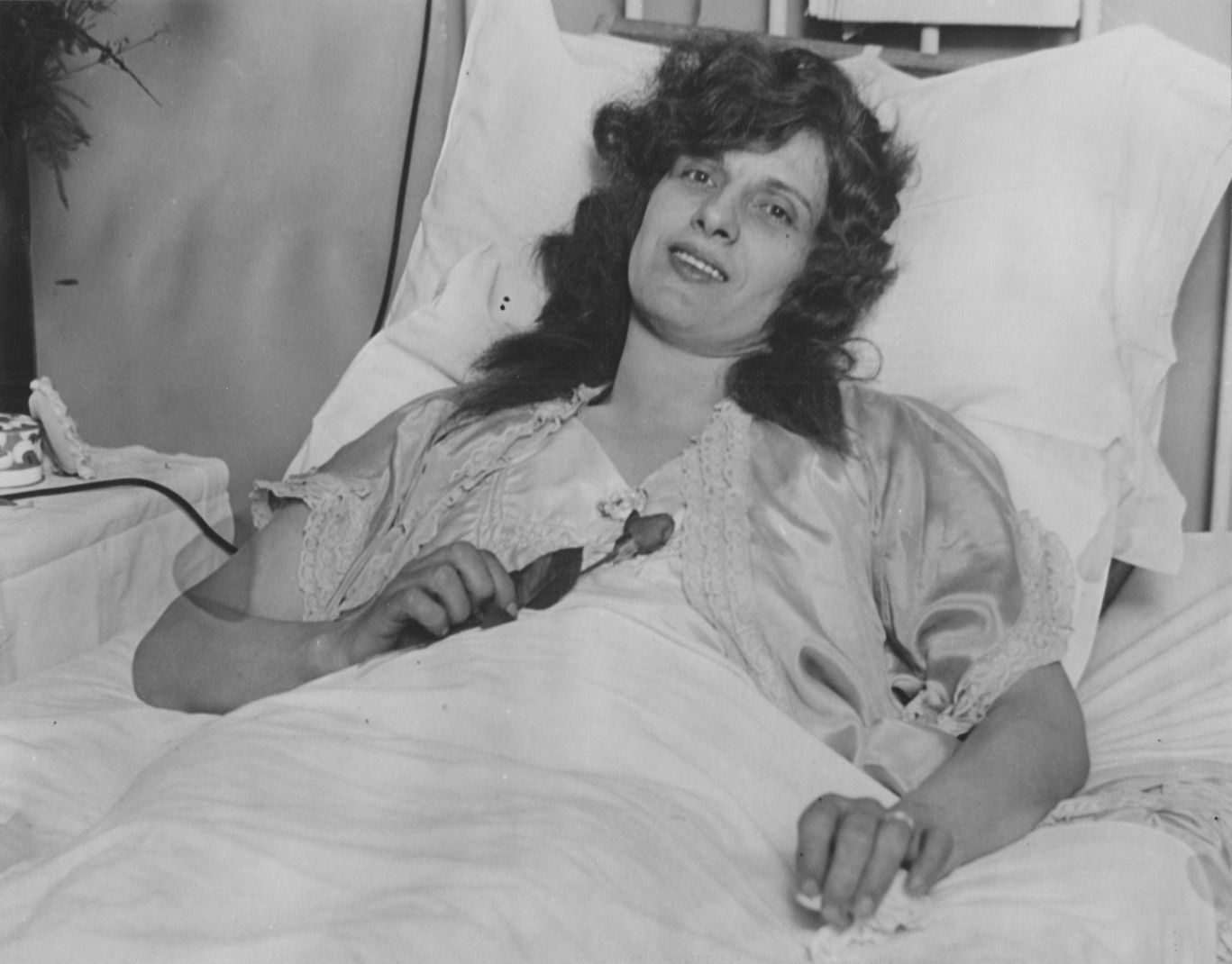
To one who has scarcely been out of a meeting since childhood, who has never had a Bible out of the reach of her hand in seventeen years, who fairly lived in the atmosphere of revival—perhaps you can imagine what joy it meant to again be in the midst of the greatest revival since the day of Pentecost.
Though still somewhat weak in body from exertion, loss of sleep and lack of food, I am stronger than ever in spirit and throwing myself into the work with the zeal and determination to carry on as before, to give the enemy no quarter, to lift up Jesus that the world may see and come to His blessed feet, and to hold the fort until He shall return in the clouds of Glory to catch His waiting church away.
IF the enemy thought to kill the work of God by this persecution, he has certainly overshot his mark. The world, over a path already well beaten from the four corners of the globe to the doors of Angelus Temple, is hurrying to Los Angeles to see what it is all about. Even at what used to be the smaller midweek services the Temple is now crowded out, necessitating overflow meetings in the new school auditorium. The altars are filled at every service, the baptistry is filled, and each week sees scores of people taking a definite stand for the cause of right and uniting with the church to stand shoulder to shoulder with us in the conflict.
We know that it is not our battle—it is God's. The outcome is in His hand, and His cause can know naught but victory.
Our business is preaching the Gospel and in the midst of it all we are calmly and steadfastly continuing with the work of calling men and women to repentance. Lifting our faces to Heaven we say humbly:
"Thy will be done, Father. Take us through."